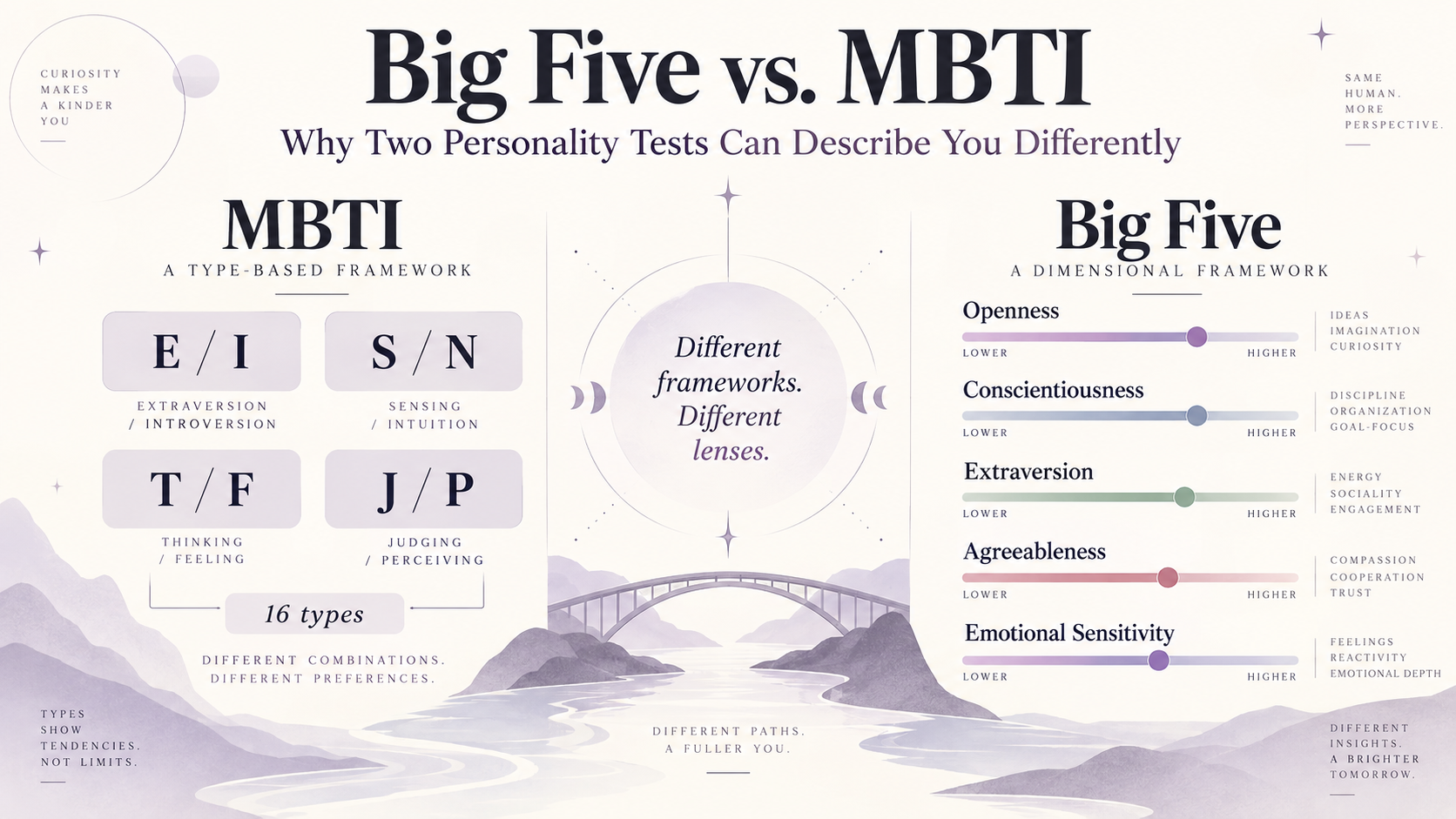
Big Five vs. MBTI
Why Two Personality Tests Can Describe You Differently
Big Five vs MBTI is a comparison many people make after receiving personality results that seem surprisingly different.
One test may describe you as introverted. Another may show moderate extraversion. One may give you a four-letter type, while another gives you scores across several personality dimensions.
Does that mean one of them is wrong?
Different personality frameworks can produce different descriptions because they are asking different questions.
✦ Big Five vs MBTI: The Main Difference
The simplest difference is structure.
The MBTI organizes personality around four preference pairs:
- Extraversion or Introversion
- Sensing or Intuition
- Thinking or Feeling
- Judging or Perceiving
Those preferences combine into one of sixteen personality types.
The Big Five works differently. Instead of assigning one overall type, it describes where you fall along five broad dimensions:
- Openness
- Conscientiousness
- Extraversion
- Agreeableness
- Neuroticism or emotional sensitivity
MBTI emphasizes preferences and types. Big Five emphasizes trait dimensions.
◎ MBTI: A Preference-Based Framework
The Myers-Briggs framework describes preferred ways of directing energy, taking in information, making decisions, and approaching the outside world.
For example, someone may receive the type INTJ.
That means the person showed preferences for Introversion, Intuition, Thinking, and Judging within the MBTI framework.
However, the official Myers-Briggs materials themselves note that the assessment does not describe every aspect of personality. :contentReference[oaicite:1]{index=1}
This matters because a four-letter type is a summary, not a complete psychological biography.
◉ Big Five: Personality on Dimensions
The Big Five does not require you to choose one side of an either-or pair.
Instead, you may fall anywhere along a continuum.
For example, you might score near the middle of extraversion.
That could mean you enjoy social interaction in some situations but also value substantial time alone.
The model therefore allows for a great deal of variation between people who might otherwise receive the same broad label.
⇄ Why Can MBTI and Big Five Results Feel Different?
Consider someone who receives an Introversion preference on MBTI.
On a Big Five assessment, that same person might score only slightly below average on extraversion.
Those results are not necessarily contradictory.
The MBTI result is expressing a preference within its framework, while the Big Five result is locating the person along a trait continuum.
“Introvert” does not always mean “extremely low in extraversion.”
✧ A Type Can Feel Clearer—But Reality May Be Messier
Personality types are attractive because they are easy to understand.
A four-letter label can feel concrete and memorable.
However, real personality often contains shades of gray.
Two people with the same MBTI type may still differ considerably in emotional sensitivity, agreeableness, sociability, discipline, or life experience.
Even Myers-Briggs materials emphasize that people with the same preference are not identical in every aspect of personality. :contentReference[oaicite:2]{index=2}
◇ What If You Are Near the Middle?
This is where categorical labels can become especially interesting.
Imagine that you are nearly balanced between extraversion and introversion.
A type-based system may still place you on one side.
A dimensional model may instead show that you are close to the midpoint.
That distinction may explain why neither “introvert” nor “extrovert” feels completely accurate.
You may not be inconsistent. You may simply fall somewhere between the extremes.
♡ Personality Can Look Different Across Situations
Another reason personality results can feel inconsistent is context.
You may be outgoing with close friends and quiet around strangers.
You may make highly analytical decisions at work while relying more on personal values in relationships.
You may prefer structure professionally but spontaneity on vacation.
Therefore, a personality test captures tendencies rather than every behavior in every situation.
✦ Which One Is More Useful?
That depends on the question you are asking.
A type framework may offer an accessible language for thinking about preferences and interpersonal differences.
A trait framework may be more useful when you want to examine personality as degrees rather than categories.
Ask the Question First
Are you trying to understand a broad personality preference?
Or are you trying to understand how strongly a trait appears?
The answer affects which framework is more informative for that particular question.
⚖ Neither Test Describes Your Entire Personality
No personality assessment captures every part of a person.
Your personality exists alongside:
- personal history
- culture
- relationships
- values
- habits
- stress
- development
- current circumstances
This is also why AuraFated avoids turning personality results into fixed identities.
A personality result should help describe you—not imprison you.
☯ What Happens When Personality Tests Agree?
Suppose both your MBTI results and Big Five profile suggest that you prefer lower levels of social stimulation.
Your life experience also supports that observation.
Perhaps you consistently recover energy through quiet time and prefer smaller gatherings.
Now several perspectives point toward a similar pattern.
That repeated pattern may be worth noticing.
✧ What Happens When They Disagree?
Suppose MBTI identifies an Introversion preference, but your Big Five extraversion score is relatively high.
Instead of immediately deciding that one test failed, ask:
What exactly does each result appear to be describing?
Perhaps you enjoy people but prefer internal reflection when making important decisions.
Perhaps your social behavior changed over time.
Perhaps one result simply fits your lived experience better.
The disagreement itself can become useful information.
⇄ The Same Principle Applies Beyond Personality Tests
AuraFated takes the same approach when comparing psychological frameworks with traditional systems such as Korean Saju.
Agreement does not prove that two systems are scientifically equivalent.
Instead, repeated themes can become questions worth exploring.
Likewise, contradictions do not need to be hidden.
Sometimes disagreement reveals more than agreement.
◉ Better Questions Than “Which Type Am I?”
Try asking:
- Which descriptions consistently fit my real behavior?
- Which results only fit in certain situations?
- Where do different assessments agree?
- Where do they disagree?
- What do people close to me notice?
- Which patterns have changed over time?
- Which tendencies help me?
- Which create recurring difficulties?
Those questions move personality testing away from collecting labels and toward actual self-understanding.
✧ Patterns, Not Personality Boxes
Whether you prefer MBTI, Big Five, or another personality framework, the goal does not have to be finding one perfect label.
Instead, each framework can offer another angle.
Patterns, Not Predictions.
Notice what repeats.
Question what does not fit.
Pay attention to context.
And keep the person larger than the test result.
Explore Yourself From More Than One Perspective
AuraFated explores personality and traditional self-discovery systems as different lenses—not as interchangeable answers.
Explore Your Free Detailed Saju Analysis✦ Explore Free Fortune Readings
✦ Complete Soul Profile
Complete Soul Profile is designed to compare multiple perspectives—including personality traits, attachment patterns, Korean Saju, and other self-reflection experiences.
Rather than simply stacking results, the goal is to examine where patterns repeat, where they conflict, and what those differences may help you understand.
Learn About Complete Soul Profile
Use the test.
Question the label.
Understand the pattern.