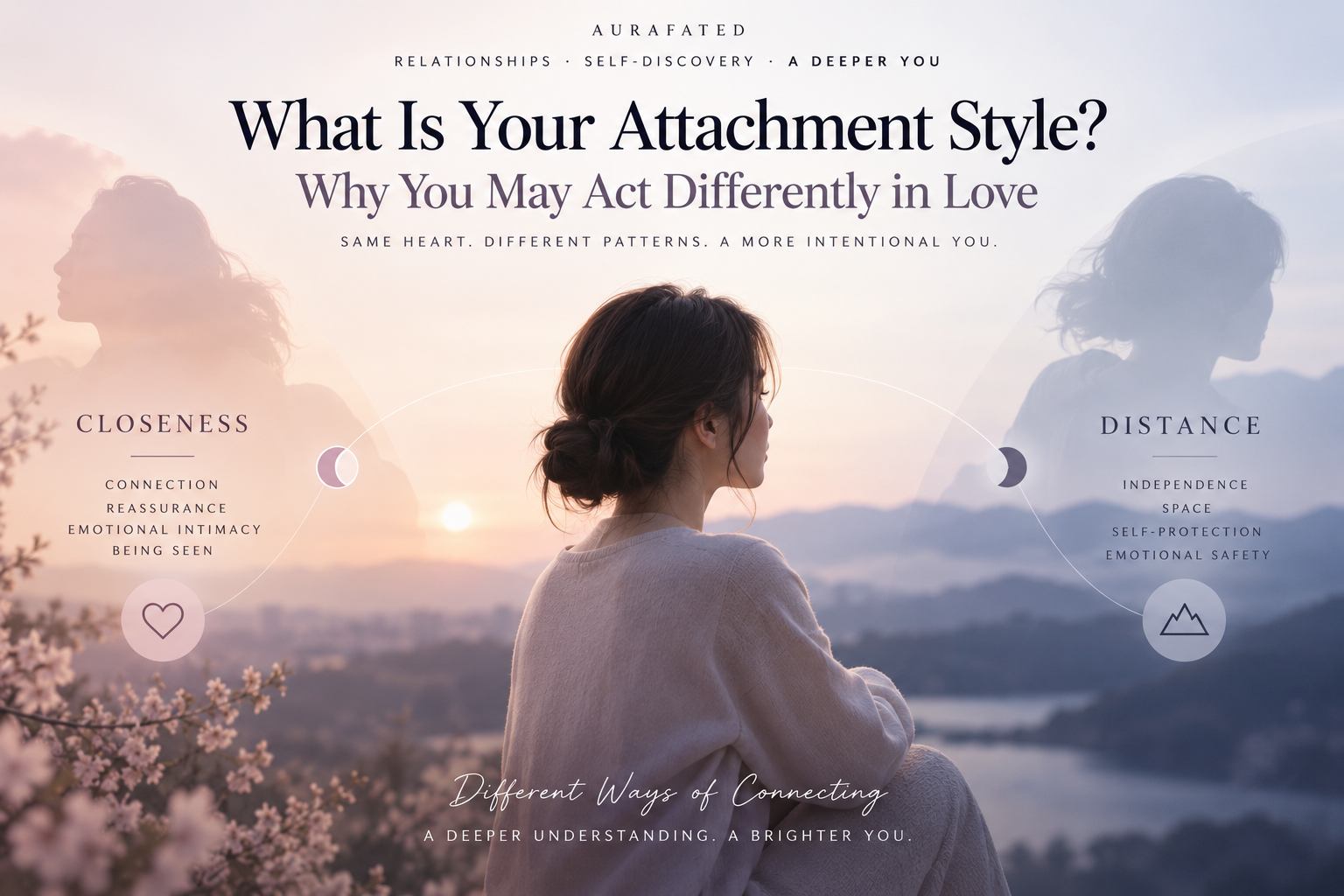
What Is Your Attachment Style?
Why You May Act Differently in Love
Attachment styles can help explain a question many people quietly ask themselves:
Why can I feel confident and independent in most of my life—yet become completely different when I care deeply about someone?
You may manage work, friendships, finances, and everyday decisions confidently.
However, when an important relationship feels uncertain, you may suddenly seek reassurance, withdraw, overthink messages, fear rejection, or struggle to express what you need.
That does not necessarily mean your personality has changed.
Instead, close relationships may activate emotional patterns that are less visible in other parts of your life.
♡ What Are Attachment Styles?
Attachment theory began as a way of understanding how early relationships with caregivers may influence emotional security and patterns of connection.
Later research extended attachment concepts into adult romantic relationships.
In adults, attachment is commonly discussed in terms of how comfortable someone feels with:
- emotional closeness
- dependence and interdependence
- trust
- reassurance
- vulnerability
- separation
- conflict
- fear of rejection or abandonment
Attachment styles are not diagnoses.
They are ways of describing recurring relationship tendencies.
◎ Four Common Attachment Patterns
People often hear attachment described using four broad categories.
Secure Attachment
Someone with relatively secure attachment may generally feel comfortable with both closeness and independence.
They may be more able to communicate needs, tolerate temporary distance, accept reassurance, and repair conflict without immediately assuming that the relationship is ending.
Common theme: “I can be close to you without losing myself.”
Anxious Attachment
People with stronger anxious tendencies may become highly sensitive to signals of rejection, distance, or uncertainty.
For example, delayed messages, changes in tone, or emotional withdrawal may trigger worry about the relationship.
They may seek reassurance, analyze interactions repeatedly, or become preoccupied with whether the other person still cares.
Common theme: “Are we okay? Do you still want me?”
Avoidant Attachment
People with stronger avoidant tendencies may value independence and become uncomfortable when emotional closeness feels too demanding or intrusive.
During conflict or emotional intensity, they may withdraw, minimize their needs, intellectualize feelings, or create distance.
Common theme: “I need space. I can handle this myself.”
Fearful or Disorganized Patterns
Some people experience both a strong desire for closeness and a strong fear of it.
They may move toward connection and then pull away when intimacy becomes emotionally intense.
As a result, relationships may sometimes feel like a cycle of approach, fear, withdrawal, and renewed longing.
Common theme: “I want to be close—but closeness also feels dangerous.”
✦ Attachment Is Better Understood as Dimensions, Not Boxes
The four labels are useful for explaining attachment in everyday language.
However, adult attachment research often examines two broader dimensions:
Attachment Anxiety
How strongly do you worry about rejection, abandonment, or whether someone truly cares about you?
Attachment Avoidance
How uncomfortable are you with dependence, vulnerability, or emotional closeness?
A person can be high or low on either dimension.
Therefore, real people do not always fit perfectly into one category.
You are not required to fit neatly into a psychological label.
⇄ Why You May Act Differently With Different People
Attachment patterns are not always expressed identically in every relationship.
For example, you may feel relatively secure with one partner but much more anxious with someone who is inconsistent or emotionally unavailable.
Likewise, someone who normally values closeness may become more avoidant when a relationship feels overwhelming.
Your behavior may therefore reflect both your own tendencies and the interaction between two people.
This is important because people sometimes ask:
“Which attachment style am I?”
A more useful question may sometimes be:
“What attachment patterns tend to appear in me, and under what conditions?”
♡ The Anxious–Avoidant Cycle
One of the most recognizable relationship patterns occurs when one person seeks increasing closeness while the other responds by creating more distance.
For example:
- One person feels distance and seeks reassurance.
- The other experiences the reassurance-seeking as pressure.
- They withdraw.
- The withdrawal increases the first person’s anxiety.
- The first person pursues more strongly.
- The second person withdraws further.
Soon, each person’s attempt to feel safer may unintentionally intensify the other person’s insecurity.
Pursuit can create distance. Distance can create more pursuit.
Seeing the cycle can sometimes be more useful than deciding which person is “the problem.”
◇ Attachment Style Does Not Explain Everything
Attachment is only one perspective on relationships.
Real relationships are also shaped by:
- personality
- communication habits
- values
- culture
- family experiences
- stress
- trust
- past relationships
- life circumstances
- the behavior of the current partner
Therefore, not every difficult relationship behavior should automatically be explained as an attachment issue.
✧ Your Attachment Pattern Is Not Your Destiny
This is especially important.
Attachment patterns should not be treated as permanent personality sentences.
People can develop new ways of relating through experience, healthier relationships, self-awareness, deliberate behavioral change, and—in some situations—professional psychological treatment.
In addition, different environments and relationships may bring out different responses.
A pattern can influence you without defining you.
☯ Where Korean Saju and Attachment Reflection Become Interesting
This is also where AuraFated’s approach becomes different.
Suppose a Korean Saju interpretation emphasizes independence, autonomy, and strong self-direction.
Meanwhile, an attachment reflection suggests strong anxiety about losing an intimate partner.
Those results may initially look contradictory.
However, the contradiction may produce a better question:
Am I independent in daily life but emotionally more vulnerable when attachment is activated?
Perhaps yes.
Perhaps not.
The important point is that AuraFated does not need to force the two systems to agree.
Instead, the difference can become something to examine against your lived experience.
◉ When Several Patterns Point in the Same Direction
Now imagine something different.
Your relationship history suggests that you repeatedly worry about abandonment.
An attachment questionnaire also suggests elevated attachment anxiety.
You notice that you frequently seek reassurance when communication changes.
In addition, close friends tell you that uncertainty in relationships seems especially difficult for you.
Several observations now point toward a similar pattern.
Repeated patterns deserve attention.
They do not require blind acceptance.
⚖ What Attachment Reflection Can—and Cannot—Tell You
It Can Help Identify Relationship Tendencies
You may notice how you typically respond to emotional distance, conflict, reassurance, closeness, or vulnerability.
It Can Help Reveal Triggers
For example, uncertainty, inconsistent communication, criticism, or perceived rejection may repeatedly activate certain responses.
It Can Help You Ask Better Questions
Instead of asking only, “Why am I like this?” you might ask, “When does this reaction happen, and what tends to activate it?”
It Cannot Diagnose You
An online attachment questionnaire or self-reflection exercise is not a psychological diagnosis.
It Cannot Tell You What Another Person Secretly Thinks
Attachment concepts may help you reflect on relationship behavior, but they cannot provide certainty about another person’s private feelings, motives, or future actions.
✦ Questions Worth Asking Yourself
Rather than focusing only on the name of your attachment style, consider these questions:
- What happens inside me when someone becomes emotionally distant?
- How easily can I ask directly for reassurance?
- Do I withdraw when people become too close?
- How do I respond during conflict?
- Do I assume silence means rejection?
- Am I comfortable depending on someone?
- Can someone depend on me without making me feel trapped?
- Do these patterns appear in every relationship or only certain ones?
- Has my relationship style changed over time?
The label matters less than understanding the pattern behind it.
✧ Patterns, Not Predictions
Attachment language can be useful when it helps you recognize recurring behavior.
However, it becomes less useful when the label becomes a fixed identity.
“I am anxious attachment, so I will always behave this way.”
“I am avoidant, so closeness simply is not for me.”
Those conclusions go too far.
Instead, attachment reflection can become one more lens through which you examine your relationships.
Patterns, Not Predictions.
Notice the pattern.
Understand the context.
Then decide what you want to do with what you have learned.
Explore More Than One Side of Yourself
AuraFated explores patterns from multiple perspectives rather than asking one system to define who you are.
Explore Your Free Detailed Saju Analysis✦ Explore Free Fortune Readings
✦ Complete Soul Profile
Complete Soul Profile is designed to bring together multiple perspectives—including attachment reflection, personality patterns, Korean Saju, and other self-discovery experiences.
The goal is not simply to collect labels, but to examine where patterns repeat, where they conflict, and what those differences may reveal.
Learn About Complete Soul Profile
Notice how you connect.
Understand what activates you.
Decide what you want to change.