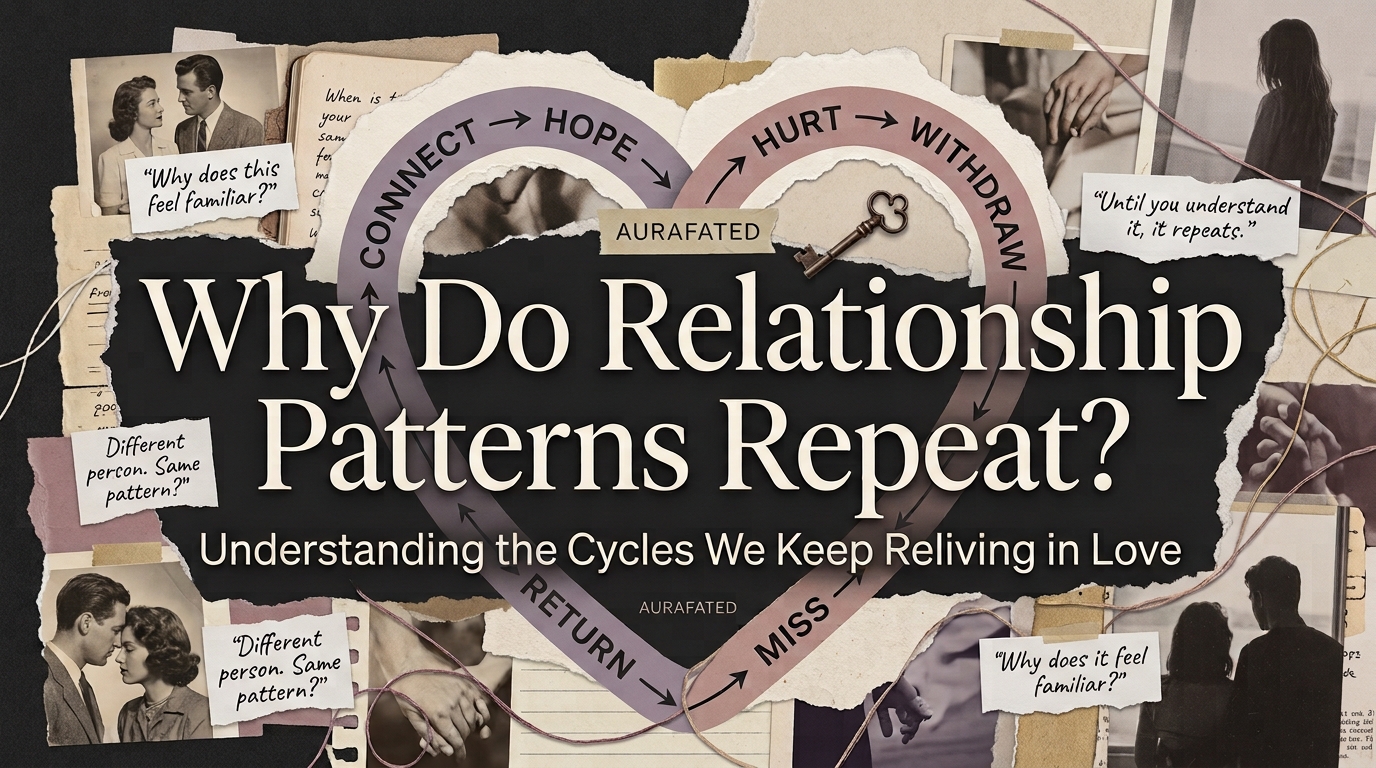
Why Do Relationship Patterns Repeat?
Understanding the Cycles We Keep Reliving in Love
Relationship patterns can be surprisingly persistent.
Different partner. Different circumstances. Different stage of life.
Yet somehow, the relationship begins to feel familiar.
“Why does this keep happening to me?”
Perhaps you repeatedly become attached to emotionally unavailable people.
Maybe relationships begin intensely and then become distant.
Perhaps you keep becoming the person who pursues, explains, reassures, fixes, or waits.
Or maybe you are the one who eventually feels overwhelmed and pulls away.
Repeating patterns do not necessarily mean you are consciously choosing the same relationship again.
Often, the repetition is more subtle.
✦ A Pattern Is More Than Choosing the Same “Type”
People often explain repeated relationships by saying:
“I just have a type.”
Sometimes that is partly true.
However, a repeating relationship pattern can involve much more than physical attraction or personality preference.
The repetition may appear in:
- how quickly you become attached
- how much reassurance you need
- what you tolerate
- how you respond to emotional distance
- how you handle conflict
- who pursues and who withdraws
- how boundaries are negotiated
- when you decide to stay or leave
In other words, the pattern may not simply be who you choose.
It may also involve what happens between you once the relationship begins.
♡ Attachment Can Shape Relationship Patterns
Attachment is one lens for understanding recurring relationship behavior.
People differ in how they respond to closeness, uncertainty, rejection, dependence, and emotional distance.
For example, someone with stronger attachment anxiety may become more alert to signs that a partner is pulling away.
Someone with stronger avoidant tendencies may become uncomfortable when emotional demands increase.
Neither response exists in isolation.
One person’s attempt to feel safer can sometimes activate the other person’s insecurity.
That is how an interaction can become a cycle.
⇄ The Pursue–Withdraw Cycle
Consider a common example.
One person senses distance and wants to talk immediately.
The other feels pressured and wants space.
The first person interprets that withdrawal as evidence that something is wrong.
As a result, they pursue more strongly.
The second person now feels even more overwhelmed and withdraws further.
The Cycle
Distance → Anxiety → Pursuit → Pressure → Withdrawal → More Anxiety
Soon, both people may believe the other person is causing the problem.
However, the more useful unit of analysis may be the cycle itself.
◇ Familiar Does Not Always Mean Healthy
Human beings often develop expectations about relationships from repeated experiences.
Those expectations may influence what feels familiar, what we notice, what we fear, and how we interpret another person’s behavior.
Importantly, familiarity does not automatically mean conscious preference.
Nor does it mean someone secretly “wants” painful relationships.
Something can feel familiar without being good for you.
A familiar emotional pattern may simply be easier to recognize than a new one.
◉ Expectations Can Influence What You Notice
Suppose you strongly expect that people eventually lose interest in you.
That expectation may affect which signals receive the most attention.
A slower reply may feel highly significant.
A tired tone may sound like rejection.
A request for space may feel like the beginning of abandonment.
Meanwhile, signs of stability may receive less attention because they do not fit the feared pattern as strongly.
Sometimes the pattern involves not only what happens—but how we interpret what happens.
✧ Emotional Triggers Can Make Old Patterns Feel Immediate
A trigger is not simply something that makes you uncomfortable.
In relationships, certain situations may activate strong emotional responses because they connect with important fears, expectations, or previous experiences.
Examples might include:
- silence after conflict
- delayed messages
- criticism
- feeling ignored
- loss of affection
- someone becoming emotionally distant
- feeling controlled
- feeling trapped
Once activated, the response may feel completely justified in the moment.
Only later may the person notice that the reaction was larger than the immediate situation alone seemed to require.
♡ Sometimes We Repeat Roles, Not Partners
A relationship pattern can also involve repeatedly occupying a familiar role.
For example:
- the rescuer
- the caretaker
- the pursuer
- the peacekeeper
- the person who waits
- the person who leaves first
- the person who avoids asking for help
Different partners can enter the story, while your role remains remarkably similar.
Sometimes the repeating question is not “Why do I choose the same person?” but “Why do I keep becoming the same version of myself?”
✦ Repetition Can Be Reinforced by What Happens Next
Patterns may continue because they sometimes work in the short term.
For example, reassurance-seeking may temporarily reduce anxiety.
Withdrawal may temporarily reduce emotional pressure.
Avoiding conflict may temporarily preserve peace.
Taking responsibility for everything may temporarily prevent disappointment.
However, a strategy that reduces discomfort immediately can still create difficulties over time.
⚖ Not Every Repeated Problem Comes From Childhood
This distinction is important.
It can be tempting to explain every relationship difficulty as a childhood wound or attachment problem.
That goes too far.
Adult relationship patterns may also be influenced by:
- recent relationship experiences
- current stress
- personality
- communication habits
- culture
- values
- life stage
- the behavior of the current partner
- practical circumstances
Therefore, noticing a pattern should open inquiry rather than automatically assign a cause.
◎ The Other Person Is Part of the Pattern Too
Relationship dynamics are interactive.
Your behavior affects the other person, and their behavior affects you.
For example, someone who usually feels relatively secure may become more anxious with a highly inconsistent partner.
Someone who usually communicates openly may begin withdrawing in a relationship where every disagreement escalates.
A relationship pattern belongs to an interaction, not always to one person alone.
That does not remove individual responsibility.
Instead, it provides a more complete picture of what is happening.
✧ Why Awareness Matters
A pattern is hardest to change when it feels like the only possible response.
Awareness creates a small amount of distance between the trigger and the reaction.
Instead of:
“They are pulling away. I need to fix this immediately.”
you may eventually be able to ask:
“I notice that uncertainty is activating me. What is actually happening, and what response would be useful?”
That difference may seem small.
But it changes the relationship between the feeling and the action.
◇ Questions That Can Reveal a Repeating Relationship Pattern
Consider asking yourself:
- What usually happens near the beginning of my relationships?
- When do I start feeling insecure, trapped, or distant?
- What kind of behavior activates me most strongly?
- What do I typically do next?
- How does the other person usually respond?
- What role do I repeatedly take?
- What do I tolerate longer than I want to?
- What do I avoid saying directly?
- Which parts of the cycle feel strangely familiar?
- What would a different response look like?
The goal is not to blame your past. It is to recognize what keeps happening in the present.
☯ Where Saju Can Become a Different Reflective Lens
AuraFated also explores Korean Saju as a separate traditional lens.
A Saju interpretation may suggest themes around independence, emotional expression, relationship tendencies, balance, or recurring life periods.
Those interpretations are not psychological diagnoses and should not be treated as scientifically validated explanations of relationship behavior.
However, a traditional interpretation can still raise questions to compare with lived experience.
For example:
Does this relationship theme actually repeat in my life?
Does my attachment reflection point toward something similar?
Where do the two perspectives disagree?
Agreement can be interesting.
Contradiction can be informative too.
♡ Repeating Patterns Do Not Mean You Are Destined to Repeat Them
Perhaps the most important point is this:
A repeated pattern is history—not destiny.
Patterns can become deeply familiar.
They can feel automatic.
They can even feel like personality.
However, recognizing the sequence creates the possibility of responding differently.
The new response may involve clearer boundaries, more direct communication, tolerating uncertainty longer, asking for what you need, slowing down, or choosing not to continue a familiar dynamic.
✦ Patterns, Not Predictions
AuraFated’s approach is not to tell you that your relationships are destined to follow one path.
Instead, the goal is to help make patterns easier to see.
Patterns, Not Predictions.
Notice what repeats.
Understand what activates it.
Recognize the role you tend to play.
Then ask whether you want to respond the same way next time.
Explore the Patterns Behind Your Relationships
AuraFated uses different lenses to help you reflect on recurring themes without allowing one interpretation to define your entire story.
Explore Your Free Detailed Saju Analysis✦ Explore Free Fortune Readings
♡ Hidden Heart
Hidden Heart is designed as an interpretive relationship experience exploring emotional dynamics, what may be expressed or held back, and themes within a connection.
It does not claim certainty about another person’s private thoughts, motives, or future actions.
Preview Hidden Heart✦ Complete Soul Profile
Complete Soul Profile is designed to compare relationship patterns, attachment reflection, personality traits, Korean Saju, and other perspectives.
The purpose is not to collect labels. It is to examine where themes repeat, where they conflict, and what those patterns may help you understand.
Learn About Complete Soul Profile
Recognize the cycle.
Understand your part in it.
Create room for a different choice.