What Is the Big Five Personality Model?
A More Nuanced Way to Understand Yourself
The Big Five personality traits offer a different way to think about personality.
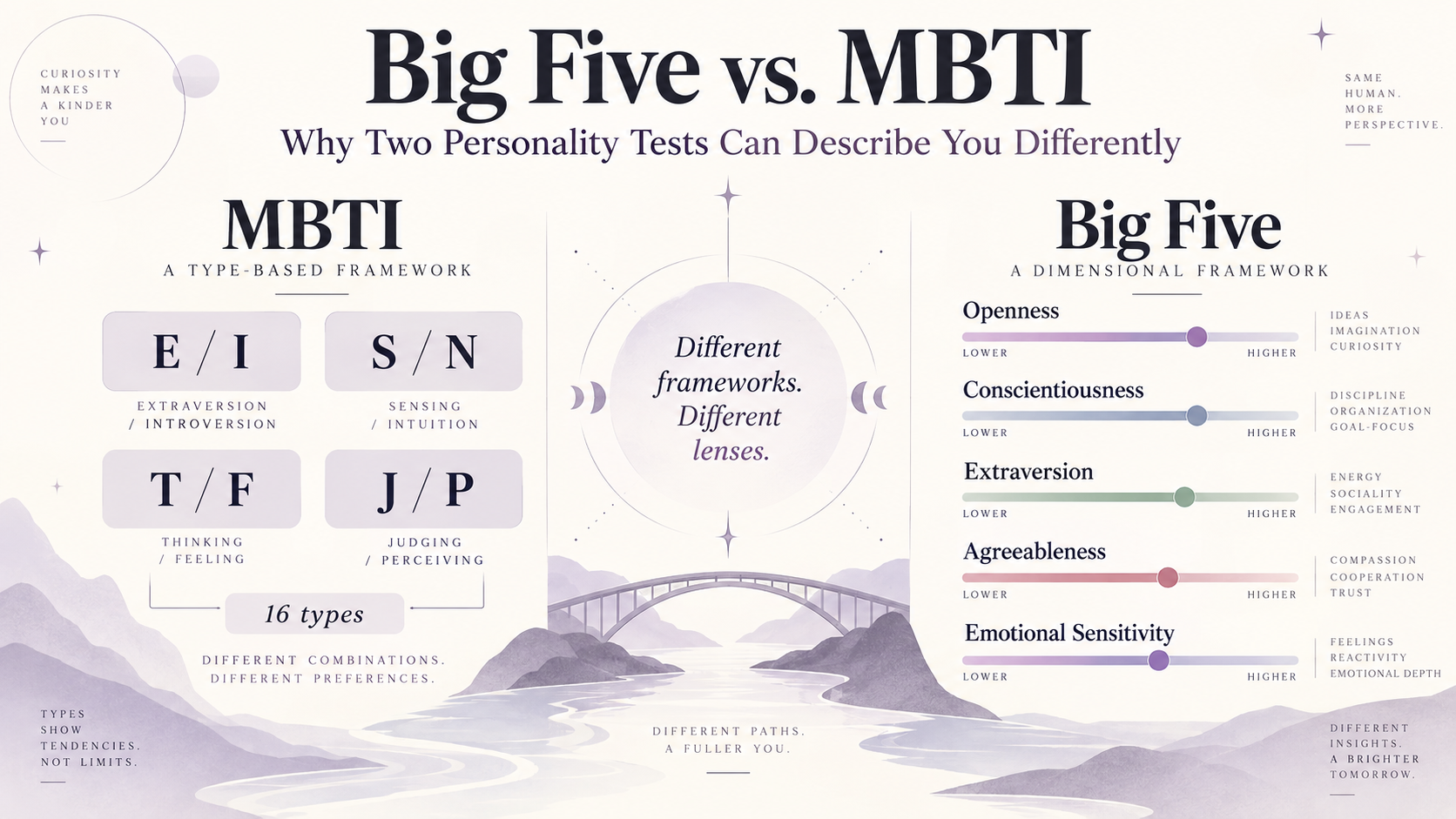
Instead of placing you into one fixed type, the Big Five describes personality across five broad dimensions.
In other words, it does not simply ask:
“What type of person are you?”
It asks something more nuanced:
Where do you tend to fall along several different personality dimensions?
That distinction matters because people are rarely just one thing.
✦ Personality Is Usually More Than a Type
Many personality systems divide people into categories.
For example, someone may be described as introverted or extraverted, emotional or logical, structured or spontaneous.
Those labels can be useful shorthand.
However, personality often works more like a spectrum than an either-or choice.
You may enjoy people but still need substantial time alone.
You may be highly organized at work but relaxed and spontaneous at home.
You may usually remain calm but become emotionally reactive under certain kinds of stress.
Personality is often better understood as a pattern of tendencies than as a single label.
◉ The Five Big Personality Dimensions
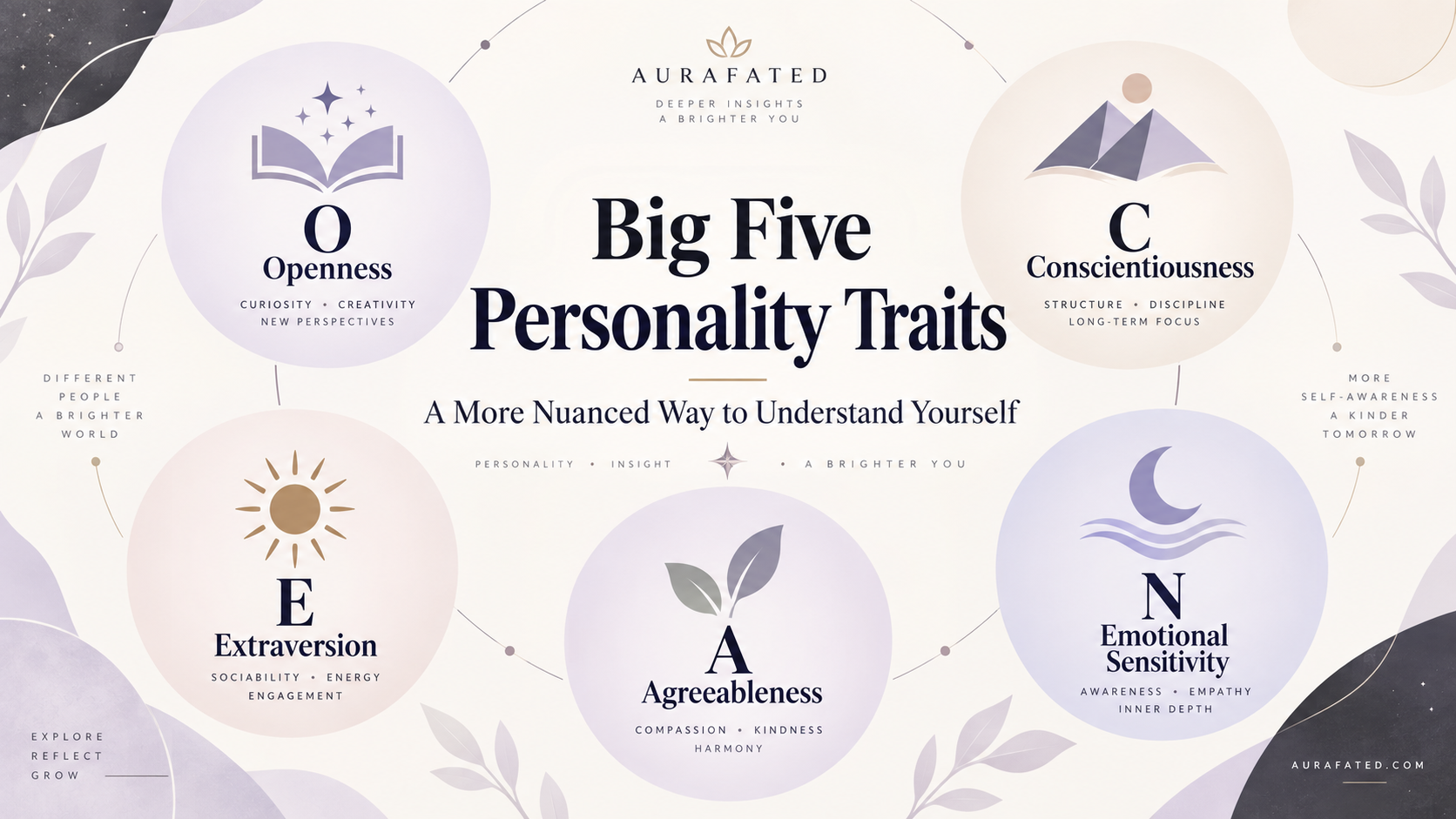
The Big Five model describes personality using five broad dimensions.
They are often remembered by the acronym OCEAN:
O — Openness
C — Conscientiousness
E — Extraversion
A — Agreeableness
N — Neuroticism, often discussed in terms of emotional sensitivity or emotional stability
Importantly, none of these dimensions is simply “good” or “bad.”
Each can involve potential strengths and potential challenges depending on context.
✧ Openness: How You Approach Ideas and Experience
Openness is associated with curiosity, imagination, interest in new ideas, creativity, and willingness to explore unfamiliar experiences.
Higher Openness May Look Like
- curiosity about new ideas
- strong imagination
- interest in art, culture, or abstract concepts
- willingness to question conventional approaches
- enjoyment of novelty and exploration
Lower Openness May Look Like
- preference for familiarity
- greater comfort with established methods
- practical rather than abstract thinking
- preference for predictability
Higher openness does not automatically mean “more intelligent,” and lower openness does not mean “less creative.”
The trait describes tendencies, not a ranking of human worth.
◇ Conscientiousness: How You Organize and Follow Through
Conscientiousness is commonly associated with organization, responsibility, self-discipline, planning, and persistence.
Higher Conscientiousness May Include
- planning ahead
- meeting deadlines
- strong attention to responsibilities
- persistence toward goals
- preference for order and structure
Lower Conscientiousness May Include
- greater spontaneity
- less rigid planning
- difficulty maintaining routines
- more flexibility around schedules and structure
Again, context matters.
Very high structure may support achievement, while excessive rigidity can sometimes make adaptation harder.
✦ Extraversion: Where You Tend to Direct Your Energy
Extraversion involves tendencies related to sociability, assertiveness, activity, positive emotional expression, and stimulation-seeking.
Higher Extraversion May Look Like
- comfort initiating conversation
- enjoyment of social activity
- greater outward emotional expression
- assertiveness
- preference for stimulation and activity
Lower Extraversion May Look Like
- preference for quieter environments
- greater comfort with solitude
- less need for frequent social stimulation
- more reserved expression
Introversion does not mean shyness, and extraversion does not automatically mean social confidence.
Those characteristics may overlap in some people, but they are not identical.
♡ Agreeableness: How You Tend to Approach Other People
Agreeableness is associated with compassion, cooperation, trust, concern for others, and interpersonal warmth.
Higher Agreeableness May Include
- empathy
- cooperation
- consideration of other people’s needs
- preference for harmony
- willingness to compromise
Lower Agreeableness May Include
- greater skepticism
- more direct disagreement
- stronger competitive tendencies
- greater willingness to challenge others
Neither end of the dimension tells the whole story.
For example, high agreeableness may support close relationships, but difficulty setting boundaries can sometimes become a challenge.
Likewise, lower agreeableness may sound negative, yet directness and skepticism can be valuable in situations that require critical evaluation.
◎ Neuroticism and Emotional Sensitivity
The term neuroticism can sound more negative than intended.
In personality research, it generally refers to tendencies involving emotional reactivity, worry, distress, sensitivity to threat, and vulnerability to negative emotions.
Higher Levels May Include
- greater emotional sensitivity
- more frequent worry
- strong reactions to stress
- greater sensitivity to uncertainty
- more difficulty returning to emotional baseline after distress
Lower Levels May Include
- greater emotional stability
- less frequent worry
- lower reactivity to stress
- greater emotional steadiness
Emotional sensitivity is not the same as weakness.
Someone who reacts strongly to stress may also notice emotional signals that others overlook.
⇄ Your Traits Work Together
One of the most important things about the Big Five personality traits is that they should not be interpreted one at a time.
The combination matters.
For example, consider two people who are both highly extraverted.
One also scores high in agreeableness.
That person may express extraversion through warmth, social connection, and collaboration.
Another person may be highly extraverted but lower in agreeableness.
Their extraversion might appear more competitive, assertive, or confrontational.
The same trait can look different depending on the rest of the personality pattern.
✦ High and Low Scores Are Not Grades
This is an important point.
A high score is not automatically better than a low score.
For example:
- high conscientiousness may support organization but can become rigidity
- high agreeableness may support compassion but can make boundary-setting difficult
- high openness may support creativity but may also increase preference for novelty
- low extraversion may support reflection and independence from social stimulation
- higher emotional sensitivity may increase distress but may also increase awareness of subtle emotional changes
Therefore, interpretation should focus on how traits function in real life rather than ranking them as good or bad.
◇ Personality Traits and Context
Even relatively stable personality tendencies do not mean you behave identically in every situation.
You may be highly conscientious professionally and much less structured at home.
You may be generally introverted but extremely expressive with close friends.
Similarly, someone who is usually emotionally stable may react strongly when facing a particularly meaningful threat or loss.
Traits describe tendencies. Context still matters.
♡ Big Five Personality Traits and Relationships
Personality tendencies can influence how people approach relationships.
For example, differences in conscientiousness may affect attitudes toward planning, household responsibilities, or reliability.
Differences in extraversion may influence how much social activity each partner prefers.
Agreeableness may affect conflict style and willingness to compromise.
Emotional sensitivity may shape how strongly someone responds to uncertainty, criticism, or interpersonal tension.
However, personality traits do not determine whether a relationship will succeed or fail.
Compatibility is not the same thing as personality similarity.
☯ What Happens When Big Five and Saju Point to Similar Themes?
This is where AuraFated becomes especially interested in comparison.
Suppose a traditional Korean Saju interpretation emphasizes structure, discipline, and responsibility.
Then a Big Five assessment suggests relatively high conscientiousness.
The two descriptions appear similar.
However, that similarity does not scientifically validate the Saju interpretation.
Instead, the repeated theme gives you something worth examining against your actual experience.
You might ask:
- Do I actually behave in a highly organized way?
- Is this true in every area of my life?
- Do other people describe me this way?
- Does structure help me or sometimes make me inflexible?
✧ What If the Two Perspectives Disagree?
Suppose your Saju interpretation suggests strong outward energy and expression.
However, your Big Five results suggest relatively low extraversion.
There is no need to force those results into agreement.
Instead, the difference may raise useful questions.
Am I expressive in certain environments but quiet in others?
Perhaps the traditional interpretation simply does not fit.
Perhaps your behavior changed over time.
Or perhaps different frameworks are describing different aspects of your experience.
The contradiction itself can become part of self-exploration.
⚖ A Personality Test Is Not a Diagnosis
Big Five personality questionnaires are designed to describe personality traits.
They are not, by themselves, mental health diagnoses.
A personality score cannot tell you that you have a psychiatric disorder.
Likewise, a high score on emotional sensitivity does not automatically mean that something is clinically wrong.
What Personality Reflection Can Do
It can help you identify tendencies, compare patterns, examine strengths, and recognize areas that may create friction.
What It Cannot Do
It cannot replace professional psychological assessment, diagnosis, psychotherapy, medical evaluation, or individualized mental health care.
◉ Your Score Is Not Your Identity
One of the easiest mistakes with personality testing is turning a result into an identity.
“I am an introvert.”
“I am neurotic.”
“I am highly conscientious.”
Those statements can become overly rigid.
A more accurate way to think might be:
“I tend to score lower in extraversion.”
“I tend to react strongly to uncertainty.”
“Organization is usually one of my stronger tendencies.”
That leaves room for context, development, and change.
✦ Better Questions to Ask About Your Personality
Instead of asking whether a score is “good,” consider asking:
- Where does this trait help me?
- Where does it create difficulties?
- Does it appear equally at work and at home?
- How does it affect my relationships?
- How do I behave when stressed?
- Which traits seem to work together?
- Have these tendencies changed as I have gotten older?
- Do the results match how people close to me experience me?
The useful question is not only “What is my score?” but “How does this pattern operate in my life?”
✧ Patterns, Not Personality Boxes
The Big Five model is useful partly because it allows people to be complex.
You do not need to belong to one personality type.
Instead, you can show different levels across several dimensions.
Those dimensions interact with your experiences, relationships, habits, culture, environment, and choices.
That fits closely with AuraFated’s broader philosophy.
Patterns, Not Predictions.
Understand the tendency.
Notice the context.
Then decide what you want to do with what you have learned.
Explore Your Patterns From More Than One Perspective
AuraFated combines self-reflection with multiple perspectives instead of asking one system to define who you are.
Explore Your Free Detailed Saju Analysis✦ Explore Free Fortune Readings
✦ Complete Soul Profile
Complete Soul Profile is designed to bring together several perspectives—including Big Five personality patterns, attachment reflection, Korean Saju, and other self-discovery experiences.
The goal is not to give you a collection of disconnected labels. It is to explore where patterns repeat, where they differ, and what those relationships may help you understand.
Learn About Complete Soul Profile
Understand the trait.
Notice the pattern.
Keep the person bigger than the label.