When Korean Saju Meets Psychology
Two Different Lenses for Understanding Yourself
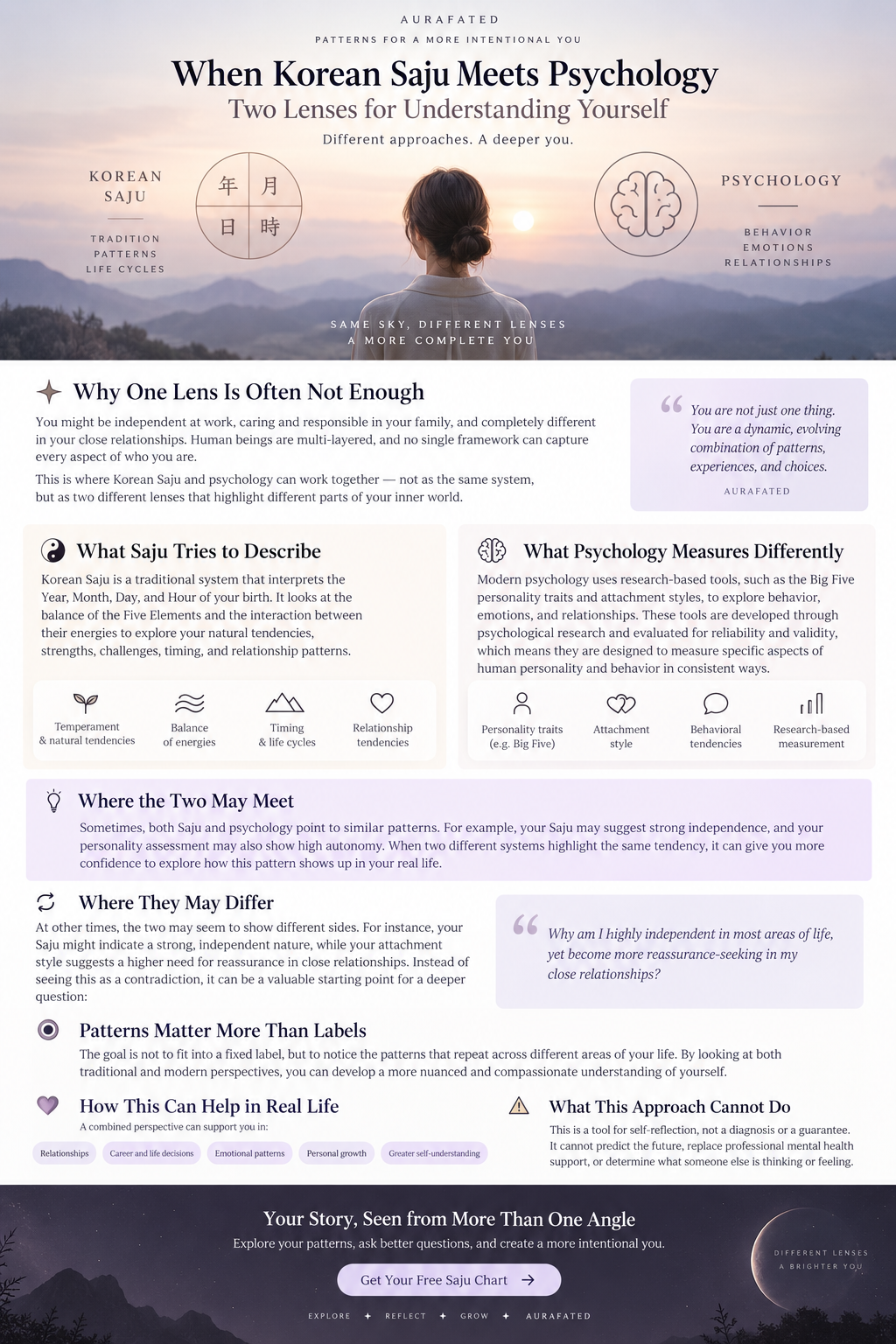
Korean Saju and Psychology come from very different traditions, but comparing them can offer two distinct lenses for understanding personality, relationships, and recurring life patterns.
One is a traditional interpretive system based on birth information. The other includes scientific disciplines that study personality, behavior, emotion, relationships, cognition, and human development.
They should not be confused with one another.
However, when they are kept clearly separate, comparing the questions they raise can create an interesting form of self-reflection.
What if two very different lenses point toward the same pattern? And what if they appear to contradict each other?
At AuraFated, that is where the conversation becomes interesting.
✦ One Person Can Contain Many Patterns
Human personality is rarely as simple as a single label.
For example, someone may be highly independent at work but deeply reassurance-seeking in romantic relationships.
Another person may appear calm and reserved socially, yet become highly expressive around family.
Someone may value stability while repeatedly choosing situations that involve uncertainty and change.
These are not necessarily contradictions.
Instead, they may reflect how different parts of us emerge in different environments, relationships, and stages of life.
Understanding yourself may require more than one lens.
☯ What Korean Saju Looks At
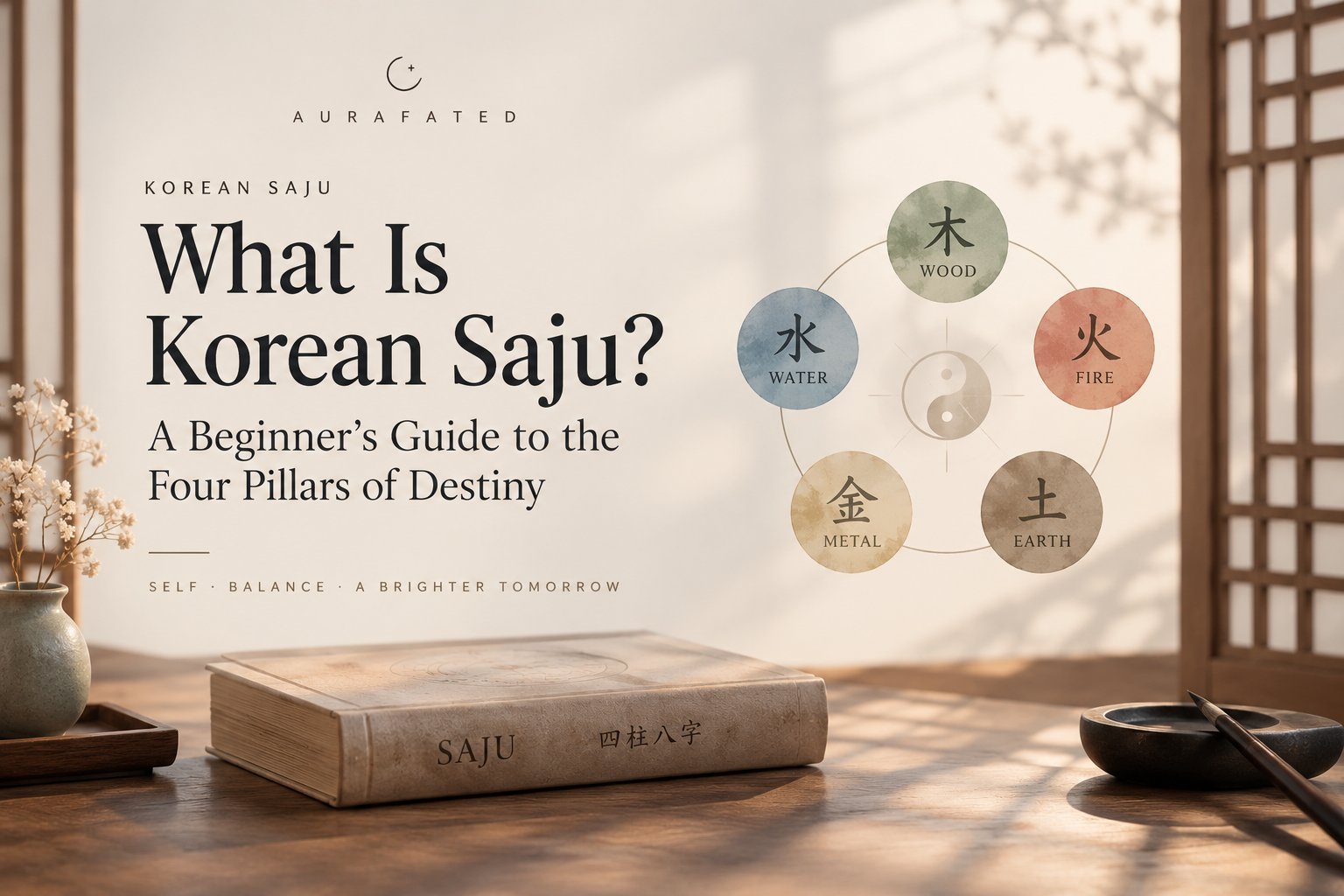
Korean Saju, also called Saju Palja (사주팔자, 四柱八字), is traditionally interpreted from the year, month, day, and hour of birth.
From these Four Pillars, traditional interpretations may examine:
- the Day Master
- the Five Elements
- Yin and Yang
- balance and tension within the chart
- traditional personality tendencies
- relationship themes
- work and career tendencies
- changing life cycles
However, Saju is a traditional interpretive framework. AuraFated does not present it as a scientifically validated personality assessment or as a method that can guarantee future events.
Its value here is different: it can provide symbolic themes and questions that a person may choose to examine against lived experience.
◉ What Psychology Looks At Differently
Psychology approaches personality and relationships through very different methods.
For example, personality research may examine broad traits such as:
- Openness
- Conscientiousness
- Extraversion
- Agreeableness
- emotional stability or Neuroticism
Other psychological frameworks may explore attachment, emotional regulation, interpersonal behavior, beliefs, habits, coping patterns, or relationship expectations.
Importantly, psychological instruments vary in quality. Scientific assessment requires attention to issues such as reliability, validity, appropriate interpretation, and whether a measure is suitable for the population and purpose for which it is being used.
Psychology and Saju are not the same kind of system—and AuraFated does not treat them as if they were.
⇄ When Korean Saju and Psychology Agree
Imagine that a traditional Saju interpretation repeatedly emphasizes independence, self-direction, and resistance to external control.
Then imagine that a personality questionnaire also suggests strong autonomy, assertiveness, and low dependence on external approval.
The similarity may feel striking.
However, it is important not to make a scientific leap from that agreement.
A psychological result agreeing with a Saju interpretation does not scientifically validate Saju.
Instead, the agreement gives you a pattern worth examining.
You might ask:
- Does this pattern actually describe me?
- Where does it appear most strongly?
- Has it helped me?
- Has it created problems?
- Do other people experience me this way?
- Has this characteristic changed over time?
In other words, the repeated theme becomes a starting point for reflection—not proof.
✧ When Korean Saju and Psychology Disagree
Korean Saju and Psychology can point to similar patterns, different patterns, or questions that become more meaningful when viewed together.
This may be even more interesting.
Suppose a Saju interpretation describes someone as strongly independent.
At the same time, an attachment reflection suggests that the person becomes highly anxious about rejection and seeks frequent reassurance in close relationships.
At first, those findings appear inconsistent.
However, instead of asking which system is “right,” consider a different question:
Why am I highly independent in most areas of life, yet become more reassurance-seeking in intimate relationships?
That question may lead somewhere meaningful.
Perhaps independence developed as a strength in work and daily life, while emotional closeness activates a different pattern.
Perhaps the person values autonomy but also fears losing important relationships.
Or perhaps the Saju interpretation simply does not fit.
All of those possibilities are more useful than forcing two systems to agree.
◇ Agreement Is Interesting. Contradiction Can Be More Useful.
People often want personality systems to confirm what they already believe.
But self-understanding does not always come from confirmation.
Sometimes the most informative question appears when two observations do not fit neatly together.
Two Different Outcomes
Agreement:
A repeated pattern may deserve closer attention.
Contradiction:
A difference may reveal context, complexity, development, or a question that has not yet been considered.
Therefore, AuraFated is not designed around the idea that every system must produce the same answer.
The differences can matter too.
♡ Relationships Are a Good Example
Relationship patterns are especially difficult to reduce to one explanation.
A traditional Saju interpretation may describe compatibility, elemental relationships, or tendencies within two birth charts.
Psychological reflection may ask different questions:
- How do you respond when you fear rejection?
- How easily do you communicate needs?
- What happens during conflict?
- How comfortable are you with emotional closeness?
- Do you withdraw, pursue, accommodate, or confront?
- What expectations do you bring into relationships?
In addition, the actual relationship includes history, trust, values, communication, circumstances, and choices.
Therefore, no birth chart—or questionnaire—should be treated as the entire relationship.
✦ The Same Person May Behave Differently in Different Contexts
One of the risks of personality labels is that they can make people sound static.
“You are independent.”
“You are emotional.”
“You are introverted.”
“You avoid conflict.”
But behavior often depends on context.
For example, someone may avoid conflict with family while being extremely assertive at work.
Likewise, someone may be socially reserved but emotionally open with one trusted partner.
As a result, AuraFated is more interested in questions such as:
When does this pattern appear?
With whom does it appear?
What seems to trigger it?
When does the opposite pattern appear?
Those questions create a more nuanced picture than a label alone.
◎ Patterns Can Change
Another important point is that people develop.
Life experiences, relationships, education, culture, responsibilities, loss, success, failure, and deliberate personal change can all influence how people think and behave.
Therefore, even when a description once felt accurate, it may not describe someone equally well forever.
A pattern can be real without being permanent.
This is one reason AuraFated avoids treating a birth-based interpretation as a fixed sentence about who someone must always be.
⚖ What This Approach Can—and Cannot—Do
It Can Help You Ask Better Questions
Comparing different perspectives may help you notice recurring themes, contradictions, strengths, sensitivities, and relationship patterns that you want to examine more closely.
It Can Encourage Reflection
A description may prompt you to compare an interpretation with your actual life rather than accepting it automatically.
It Can Reveal Context
Apparently conflicting results may encourage you to ask why you behave differently across work, family, friendship, or intimate relationships.
But It Is Not Diagnosis or Therapy
AuraFated is not providing psychological diagnosis, psychotherapy, psychiatric evaluation, medical advice, or licensed psychological services.
And It Does Not Guarantee the Future
Traditional symbolic systems should not be used to claim certainty about future events or another person’s private thoughts.
✧ The Most Important Test Is Your Lived Experience
Suppose several systems describe you as highly organized.
Yet you know that you struggle significantly with organization.
Your lived experience matters.
Perhaps the interpretation does not fit.
Alternatively, perhaps you strongly value structure but have difficulty maintaining it.
Or perhaps you are organized professionally but disorganized personally.
The point is not to force yourself into a result.
You should not have to change your story to make an interpretation look correct.
☯ Why AuraFated Brings Different Lenses Together
AuraFated was created around a simple idea:
No single framework should be allowed to define an entire person.
Korean Saju may offer one traditional lens.
Psychology and personality research can offer other forms of information.
Personology and symbolic traditions may raise still other questions.
Meanwhile, your family history, relationships, culture, experiences, and personal choices add information that none of those systems can fully capture.
Therefore, the goal is not to make every framework agree.
The goal is to look for what is useful.
When different lenses agree, notice the pattern.
When they disagree, examine the question.
✦ Patterns, Not Predictions
That leads back to AuraFated’s central principle:
Patterns, Not Predictions.
A pattern is something you can examine.
A pattern can have context.
A pattern can become stronger or weaker.
A pattern can help you—or create difficulties.
Most importantly, a pattern does not have to become your destiny.
Explore Your Own Patterns
Start with AuraFated’s free Saju experiences, then explore other perspectives when you are ready.
Explore Your Detailed Saju Analysis✧ Free Life Fortune ✦ Free Fortune Readings
✦ Complete Soul Profile
AuraFated’s deeper self-discovery experience is designed to compare multiple perspectives rather than simply placing separate test results side by side.
The focus is on where patterns repeat, where they differ, and what those similarities or contradictions may help you explore.
Learn About Complete Soul Profile
Understand the pattern.
Question the label.
Decide what comes next.