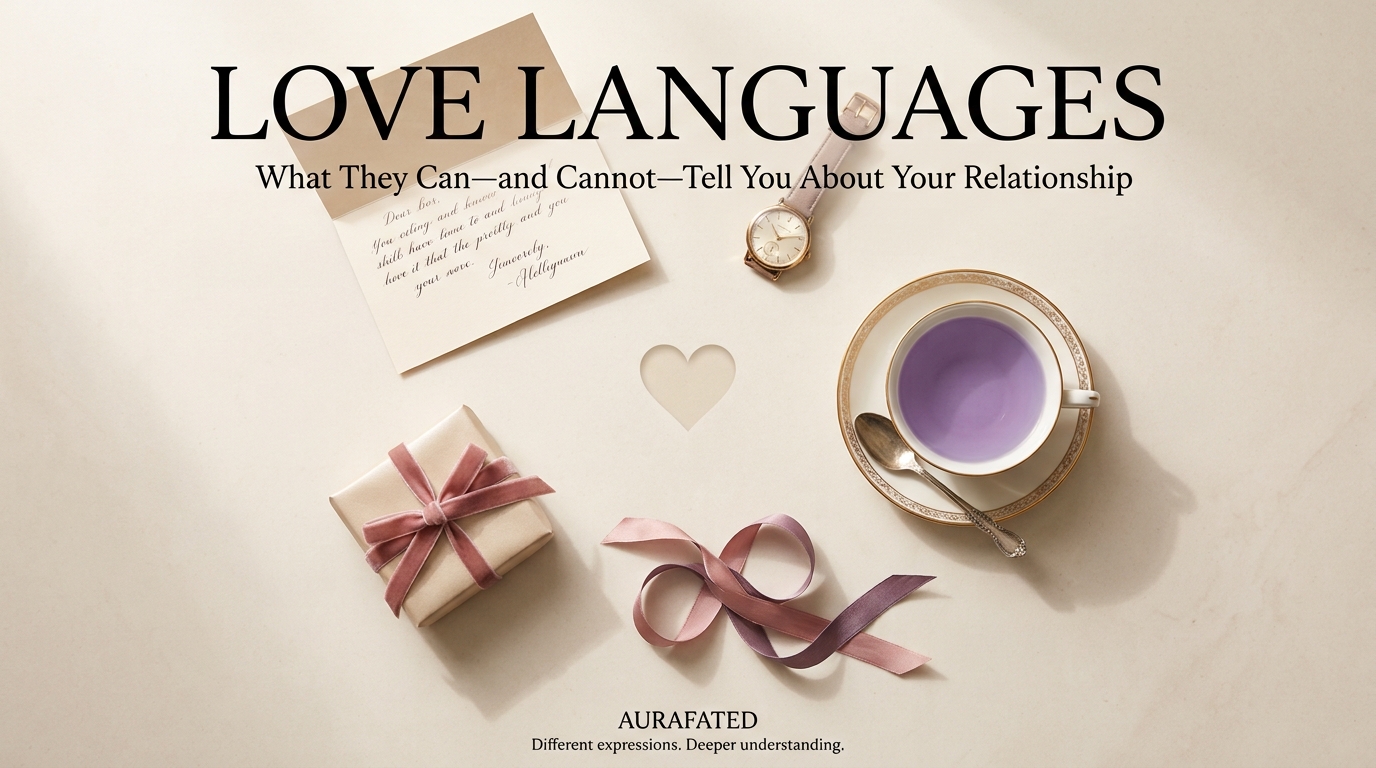
Love Languages
What They Can—and Cannot—Tell You About Your Relationship
Love languages are popular because they describe something almost everyone has experienced:
“I know you care about me—but sometimes I do not feel loved in the way I need.”
One person expresses affection by helping.
Another wants words.
Someone else values physical closeness, uninterrupted time together, or thoughtful gifts.
The idea is easy to understand because it gives couples a vocabulary for talking about those differences.
However, problems begin when a useful conversation tool becomes a rigid personality label.
♡ What Are the Five Love Languages?
The popular five-language framework describes five broad ways people may give or receive affection.
Words of Affirmation
Affection may feel especially meaningful when it is expressed verbally.
Examples can include appreciation, encouragement, reassurance, praise, or simply saying what the other person means to you.
Quality Time
For some people, focused attention communicates care.
What matters may be less about the activity itself and more about feeling that the other person is genuinely present.
Acts of Service
Actions can communicate affection.
Helping with a difficult task, preparing something thoughtful, or taking responsibility when a partner is overwhelmed may feel more meaningful than words alone.
Physical Touch
For some people, appropriate physical affection plays an important role in connection.
This can include holding hands, hugging, sitting close, or other mutually wanted forms of physical closeness.
Receiving Gifts
The meaning is not necessarily the price of an object.
For some people, a thoughtful gift symbolizes:
“You remembered me. You thought about me. You noticed what mattered to me.”
✦ Why Love Languages Feel So Useful
One reason the idea resonates is that people do not always express affection in the same way.
Imagine one partner frequently does practical things for the other.
They cook, repair things, handle errands, and make life easier.
To them, those actions may clearly mean:
“I love you.”
Meanwhile, the other partner may be waiting to hear:
“I appreciate you.”
“I am proud of you.”
“You matter to me.”
Both may care deeply.
Yet each may feel that the other person is failing to communicate love.
⇄ Giving Love and Receiving Love May Be Different
Another interesting point is that how you naturally express affection may not be identical to what you most want to receive.
For example, you may frequently help people through acts of service because that comes naturally to you.
However, when you are emotionally vulnerable, you may want reassurance and words of affirmation.
How I show love and how I most notice love do not always have to be the same.
◇ Context Can Change What You Need
Your preferred form of affection may also change with circumstances.
When life is calm, quality time may feel especially important.
When you are exhausted, an act of service may suddenly mean much more.
After conflict, you may need words of reassurance.
During grief or fear, physical closeness may become especially meaningful.
Therefore, it may be too simplistic to assume that every person has one permanent language that remains unchanged across all situations.
◉ A Love Language Is Not a Diagnosis
A love-language result should not be treated like a clinical psychological assessment.
It does not diagnose your relationship.
It cannot determine whether a relationship is healthy.
It cannot establish compatibility by itself.
And it cannot explain every reason you do or do not feel loved.
“My love language is X” can start a conversation. It should not end one.
♡ Your Partner Does Not Owe You Only One Form of Love
Another problem occurs when love languages become rules.
For example:
“My love language is gifts, so if you loved me you would buy me things.”
That interpretation misses an important point.
A preference can help communicate what matters to you.
However, relationships also require consent, boundaries, circumstances, resources, compromise, and mutual respect.
A language of affection should support communication—not become a demand that proves whether someone loves you.
✧ Love Languages and Attachment Are Different
This distinction is especially useful for AuraFated.
A love language asks something like:
“What kinds of affection tend to feel meaningful to me?”
Attachment asks different questions:
- What happens when closeness feels uncertain?
- How do I respond to rejection?
- Do I seek reassurance?
- Do I withdraw when intimacy becomes intense?
- How comfortable am I depending on another person?
These are not interchangeable concepts.
For example, two people may both prefer quality time but react completely differently when the relationship feels threatened.
⇄ The Same Love Language Can Hide Different Needs
Suppose two people both say that Words of Affirmation are especially important.
For one person, words may simply be a meaningful expression of warmth.
For another, verbal reassurance may become especially important when they fear abandonment.
The visible preference looks similar.
The emotional pattern underneath it may be quite different.
The behavior can look the same while the need underneath it is different.
✦ What Happens When Partners Have Different Preferences?
Differences do not automatically mean incompatibility.
Imagine one partner values quality time and the other naturally expresses love through acts of service.
The second partner may think:
“I do everything for us. How could you not know that I care?”
The first may think:
“We are always busy. I just want you to sit down and be with me.”
Neither person necessarily lacks affection.
The issue may be translation.
Sometimes love is present, but its signal is being interpreted differently.
⚖ But Not Every Relationship Problem Is a Love-Language Problem
This is an important limitation.
If a relationship includes chronic disrespect, manipulation, dishonesty, coercion, unsafe behavior, or repeated boundary violations, simply learning each other’s love language does not solve the underlying problem.
Likewise, serious conflict may involve:
- trust
- communication
- attachment
- values
- expectations
- emotional regulation
- responsibility
- relationship history
A preference for affection is only one piece of a much larger relationship.
◇ Ask About Behaviors, Not Just Labels
Instead of stopping at:
“My love language is Quality Time.”
go one step further.
Ask:
- What does quality time actually mean to me?
- How much do I need?
- Does watching television together count?
- Do I need conversation?
- Do phones need to be put away?
- Do I want shared activities?
- When do I notice its absence most strongly?
The behavioral details are often more useful than the label.
♡ Your Preferences May Have a History
Sometimes it is worth asking why a particular expression of love carries so much meaning.
Perhaps verbal appreciation was rare in your family.
Maybe practical help was how affection was traditionally expressed.
Perhaps gifts became meaningful because someone important always remembered small details about you.
Or perhaps physical affection was consistently associated with safety and connection.
There does not have to be a dramatic explanation.
However, understanding the history behind a preference may provide more insight than simply naming it.
☯ Where Korean Saju Adds a Different Lens
AuraFated may also compare relationship reflections with traditional Korean Saju themes.
For example, a Saju interpretation may traditionally describe a person as restrained in emotional expression.
Yet that same person may report that Words of Affirmation are especially important to receive.
Those two observations raise an interesting question:
Do I have difficulty expressing verbally what I strongly need to hear from someone else?
Maybe.
Maybe not.
The point is not to use one system to prove the other.
Instead, the comparison creates another question to examine against real experience.
◉ What If Different Relationship Tools Point to the Same Pattern?
Suppose several things appear together:
- you strongly value Words of Affirmation
- you frequently seek reassurance during uncertainty
- your attachment reflection suggests higher attachment anxiety
- past relationships show repeated concern about whether you are valued
Those observations do not automatically create a diagnosis.
However, together they may suggest that reassurance plays an especially important role in your relationships.
One result is interesting.
A repeating pattern deserves closer attention.
✧ Better Questions to Ask About Love Languages
Instead of asking only “What is my love language?” try:
- How do I naturally express affection?
- What makes me feel especially cared for?
- Does that change when I am stressed?
- What do I expect my partner to notice without being told?
- Which forms of affection are hardest for me to give?
- Which are hardest for me to receive?
- Do my preferences change between relationships?
- Does my partner know what specific behaviors matter to me?
- What happens when my needs are not met?
The deeper question is not just “How do I want to be loved?” but “What happens inside me when I do—or do not—feel loved?”
✦ Love Languages Are a Starting Point, Not a Personality Box
A love-language label can be useful when it helps two people communicate.
It becomes less useful when it is treated as a permanent identity or a test of love.
People are more complex than one preferred form of affection.
Needs change with context.
Relationships change over time.
And different emotional patterns can exist beneath similar behaviors.
✧ Patterns, Not Predictions
At AuraFated, a Love Language Profile is most useful as one perspective among several.
It can be considered alongside personality, attachment, relationship history, Korean Saju, and your lived experience.
Patterns, Not Predictions.
Learn what matters to you.
Understand why it matters.
Communicate it clearly.
And keep the relationship bigger than the label.
Explore Your Relationship Patterns
AuraFated explores relationships from multiple perspectives rather than allowing one test or symbolic system to define your connection.
Explore Your Free Detailed Saju Analysis✦ Explore Free Fortune Readings
✦ Complete Soul Profile
Complete Soul Profile is designed to bring Love Language reflection together with personality traits, attachment patterns, Korean Saju, and other self-discovery perspectives.
The purpose is not to collect separate labels, but to examine how your patterns connect.
Learn About Complete Soul Profile
Name the preference.
Understand the need beneath it.
Communicate what matters.