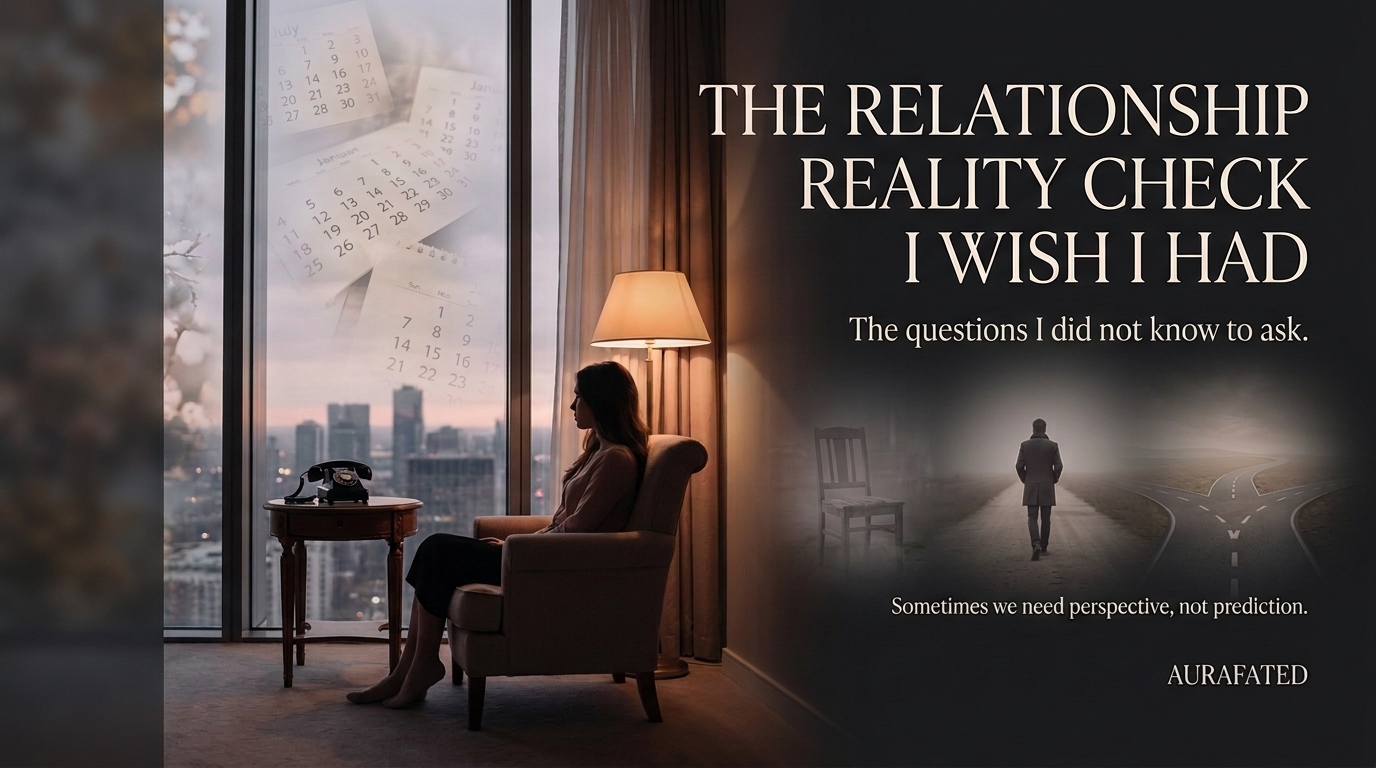
The Relationship Reality Check I Wish I Had
What I learned about experience, perspective, and seeing a relationship more clearly.
A relationship reality check is something I wish I had when I was younger. At the time, I was intelligent, independent, capable, and accustomed to solving problems on my own. But I was inexperienced in love—and those are not the same thing.
I was intelligent, capable, and independent—but I was inexperienced in love.
✦ I Thought I Had a Boyfriend
When I was younger, I stayed in a relationship for about six years. In my mind, he was my boyfriend. The relationship was emotionally and physically meaningful to me, and I treated it seriously.
We did not see each other very often. Sometimes he would contact me about once a month, and then we would meet. I rarely questioned the pattern because I assumed he was busy. I did not call whenever I wanted to see him, and I did not push for more time. At the time, I thought I was simply being patient and understanding.
♡ The Signs Were There, but I Did Not Know How to Read Them
Looking back, some of the signs were not invisible. He sometimes told me that he had gone on arranged dates with other women. Today, that information would immediately make me ask questions about exclusivity, commitment, and how each person understood the relationship.
At the time, however, I did not know how seriously I should interpret those behaviors. I had very little romantic experience to compare my situation with, and I tended to process questions privately instead of asking other people for perspective.
I kept trying to understand him instead of stepping outside the relationship and asking what the relationship itself was showing me.
⇄ Six Years Passed, but the Relationship Did Not Move Forward
As the years passed, marriage and long-term partnership naturally became more relevant to my life. Yet we still were not meaningfully planning a future together.
There was history. There was intimacy. There were feelings. But there was very little evidence that the relationship was progressing toward a shared life.
A relationship can continue for a long time without actually moving forward.
◉ Meanwhile, I Was Making Decisions Based on the Relationship
Because I believed I was already in a committed relationship, I turned away other men who were interested in me. In my mind, I already had someone. I believed loyalty mattered, and I behaved according to that belief.
What I did not understand was that my perception of the relationship and his demonstrated level of commitment were not necessarily the same.
◇ What I Eventually Learned
After about six years, I learned that he had been dating other women and was preparing to marry someone else. I later understood that there had been multiple relationships occurring during the period when I believed I was committed to one person.
He later told me that he felt sorry for me and that he could not bring himself to tell me. I cannot know everything he thought or exactly why he made the choices he made. What I can know is what happened.
The central problem was not simply that he contacted me infrequently. I had been making important decisions about my own life based on a relationship reality that was materially incomplete.
✧ What I Lacked Was Not Intelligence
It would be easy to look backward and ask how I could have missed what now seems obvious. But I no longer think that is the most useful way to understand what happened.
I was capable of reasoning. I was capable in my career and in many other parts of life. What I lacked was experience in a particular domain—and an objective framework for evaluating a relationship when I was emotionally inside it.
What I lacked was not intelligence. I lacked experience, perspective, and an objective way to evaluate what the relationship was actually showing me.
My independence may also have played a role. Being able to solve problems alone is often a strength. But in an ambiguous relationship, handling everything privately can mean remaining inside your own interpretation for too long.
⚖ The Questions I Wish Someone Had Asked Me
With more experience, I might have asked different questions much earlier:
- Who controls when we communicate or see each other?
- Have we actually discussed whether this relationship is exclusive?
- Why is the other person continuing to meet potential romantic partners?
- Has the relationship become more integrated over time?
- Am I included in their future plans?
- Are their actions consistent with the relationship I believe we have?
- What am I giving up because I believe this relationship has a future?
Those questions seem straightforward to me now. They were not straightforward to me then.
If your closest friend described this exact relationship to you, what would you tell them?
♡ Sometimes You Do Not Need to Read Someone’s Mind
When relationships become confusing, people naturally want to know what the other person is thinking. Does this person really love me? Why are they pulling away? Are they afraid of commitment? Do they secretly see a future with me?
Those questions are understandable, but some of the most useful information may already be visible in behavior.
- Is effort mutual?
- Is access to one another reasonably balanced?
- Is exclusivity clear?
- Is the relationship progressing?
- Are words and actions consistent?
- Are you becoming more integrated into each other’s lives?
- Is commitment becoming clearer with time?
You do not always need access to someone’s mind. Sometimes the behavior already contains important information.
◎ What Do I Know, and What Am I Assuming?
One of the most useful distinctions in relationship reflection is the difference between observation and interpretation.
For example, “We have been together for six years and have never discussed a shared future” is an observation. “They are afraid of commitment” is an interpretation. “They contact me roughly once a month” is an observation. “They are simply too busy to contact me more often” is an interpretation.
Interpretations may sometimes be correct. The problem begins when we treat assumptions as established facts.
Ask yourself: What do I actually know? What am I assuming? What has this person consistently done? What has changed? What has not?
✦ Duration Is Not the Same as Progression
One lesson from my experience is that the length of a relationship should not be confused with the development of a relationship. Time can pass while commitment remains unchanged.
A relationship that lasts several years may still have very little future integration, very little clarity about exclusivity, and very little progression toward a shared life.
Duration increased, but commitment indicators did not necessarily increase with it.
That distinction matters because people can become increasingly invested simply because more time has passed. Yet the other person’s demonstrated commitment may remain essentially where it began.
⇄ Relationship Experience Is Its Own Kind of Knowledge
Intelligence does not automatically provide experience. Someone can be highly educated, professionally successful, independent, and capable of making complex decisions while still having very little experience recognizing romantic ambiguity.
The reverse can also be true. Someone with more relationship experience may notice a pattern immediately that a highly accomplished but inexperienced person does not recognize.
That is one reason outside perspective can be useful. It does not mean another person should make the decision for you. It means a second perspective may reveal questions that you did not know to ask.
♡ My Story Did Not End There
My life moved forward. Eventually, I met a good partner and built a happy life. That earlier relationship no longer defines me, but it taught me something that stayed with me.
Being intelligent and capable does not automatically make us experienced in love.
Some people have close friends who will immediately question a confusing relationship. Others are more private. Some prefer to solve things alone. Some are experiencing their first serious relationship and simply do not have a reference point for what they are seeing.
From inside the relationship, uncertainty can feel normal because it developed gradually. From outside, the same pattern may look very different.
◇ Why I’m Building Relationship Reality Check
That experience is one reason I want AuraFated to include a deeper Relationship Reality Check. It is not intended to tell someone whom to love, whether to stay, or whether to leave. It also should not pretend to know another person’s secret thoughts.
Instead, the purpose is to organize the relationship information that is actually available and help a person examine it from outside the immediate emotion.
Relationship Reality Check can examine patterns such as:
- reciprocity
- relationship access
- commitment
- exclusivity
- future integration
- progression over time
- consistency
- emotional availability
- clarity
It can also ask about information that ordinary compatibility quizzes often overlook: what has remained unchanged over time, whether important information has been withheld, whether parallel relationships exist, and what opportunities someone may be giving up because of their understanding of the relationship.
◉ The Goal Is Perspective, Not a Verdict
A useful relationship tool should not reduce an intimate relationship to a percentage score or declare that another person definitely loves you, does not love you, will commit, or will leave.
Instead, it can help separate observable evidence from interpretation, identify contradictions, and show where important information is still missing.
What supports the relationship?
What weakens it?
What is clearly demonstrated?
What are you filling in through assumption?
What question would materially change your understanding of the relationship?
☯ Another Lens Within AuraFated
AuraFated was created around the idea that one person can be understood through more than one lens. Korean Saju, psychology, personality, symbolic traditions, and lived experience can each offer a different perspective.
Relationship Reality Check grows from the same philosophy. Instead of asking only what someone might feel, it adds another lens: what the relationship itself is showing through behavior, consistency, reciprocity, and time.
Sometimes understanding a relationship requires the same thing as understanding yourself: more than one perspective.
✧ Patterns, Not Predictions
We cannot know everything another person is thinking. We cannot reliably predict every choice they will make. But relationships do give us information.
They give us patterns of effort, consistency, reciprocity, disclosure, progression, and commitment. Those patterns cannot tell us everything—but they may tell us enough to ask a better question.
Patterns, Not Predictions.
Explore Your Relationship Patterns
AuraFated explores relationships through multiple perspectives while keeping observation, psychological reflection, and traditional interpretation clearly distinct.
Explore Free Readings♡ Hidden Heart
Hidden Heart is designed to explore the dynamics between two people using available birth information, relationship patterns, emotional themes, and multiple interpretive perspectives.
It does not claim certainty about another person’s private thoughts, motives, or future actions.
Preview Hidden Heart✦ Complete Soul Profile
Complete Soul Profile is designed to bring together psychological reflection, personality patterns, Korean Saju, and other self-discovery perspectives.
The focus is on where different perspectives agree, where they conflict, and what repeated patterns may help you understand.
Learn About Complete Soul Profile
Observe what happened.
Separate what you know from what you assume.
Then decide what you need to ask.