Can You Really Understand Someone Else’s Psychology?
A Better Way to Read Relationship Patterns
Relationship psychology can help us understand patterns between two people—but it cannot give us direct access to another person’s private thoughts.
That distinction matters.
People often want answers to questions like:
- Does this person really care about me?
- Why do they pull away?
- Why do they act warm one day and distant the next?
- Are they afraid of commitment?
- Why do they avoid talking about feelings?
We can observe behavior. We can identify patterns. But we should be careful about claiming certainty about another person’s inner world.
✦ What Can We Actually Observe?
When trying to understand another person, the strongest information usually comes from observable behavior.
For example:
- How consistently do they communicate?
- Do their actions match their words?
- How do they respond when conflict begins?
- Do they move closer or farther away under stress?
- Can they express affection directly?
- Do they respect boundaries?
- Do they follow through on commitments?
- Do they respond to your emotional needs?
These behaviors do not reveal everything about a person.
However, they provide more useful information than guessing what someone is secretly thinking.
♡ Behavior Is Not the Same as Motive
Suppose someone becomes quiet after conflict.
Several explanations are possible.
They may need time to regulate their emotions.
In some cases, they may simply feel overwhelmed.
Alternatively, they may be avoiding the discussion.
Sometimes anger may be part of the response.
At other times, they may not know what to say.
The behavior is observable. The motive requires interpretation.
That is why responsible relationship analysis should distinguish between what happened and what might explain it.
◉ Attachment Can Offer One Psychological Lens
Adult attachment research often considers two broad dimensions: attachment anxiety and attachment avoidance.
People higher in attachment anxiety may become more sensitive to rejection or separation and may seek reassurance when a relationship feels uncertain.
People higher in attachment avoidance may be more uncomfortable with dependence or emotional vulnerability and may create distance when closeness feels stressful.
However, attachment patterns are not mind-reading tools.
They describe tendencies, not hidden thoughts.
“They withdrew” is an observation. “They withdrew because they are avoidantly attached” is an interpretation that requires more evidence.
⇄ The Relationship Between Two People Matters
One of the most useful shifts is to stop analyzing only one person.
Relationships are interactive.
Your response affects them.
Their response affects you.
Then your reaction to their response influences what happens next.
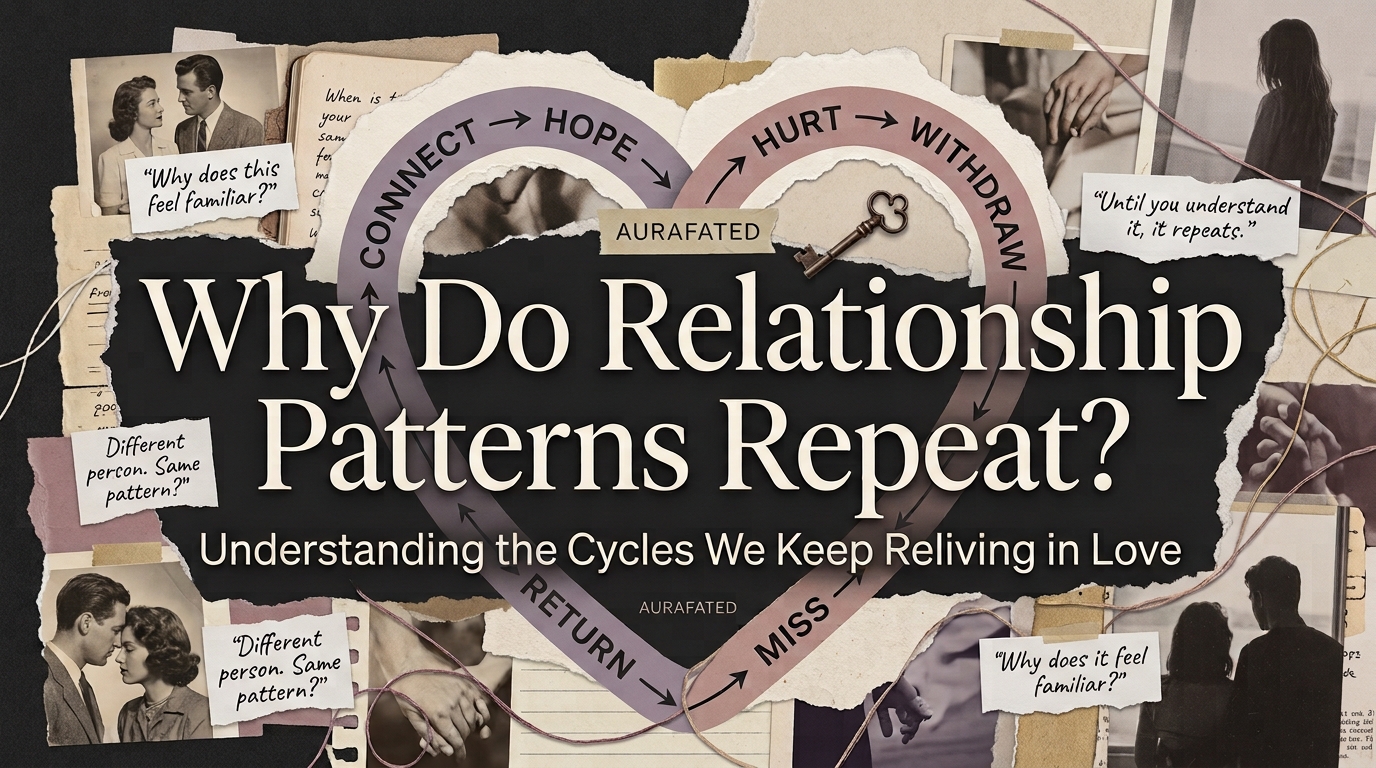
Over time, a repeating cycle can develop.
Example
You sense distance.
You ask for reassurance.
They experience the request as pressure.
They withdraw.
Their withdrawal increases your anxiety.
You pursue harder.
The useful question may therefore be less:
“What is wrong with them?”
and more:
“What pattern is being created between us?”
✧ Compare Needs, Not Just Personalities
Two people can like each other and still have very different emotional needs.
For example:
Person A
Wants frequent communication.
Values verbal reassurance.
Prefers discussing conflict immediately.
Person B
Needs more personal space.
Shows affection through actions rather than words.
Needs time before discussing conflict.
Neither pattern is automatically wrong.
However, without understanding those differences, both people may misinterpret the other.
Person A may experience space as rejection.
Person B may experience reassurance-seeking as pressure.
◇ Communication Style Provides Important Clues
Another useful dimension is how someone communicates.
Look for patterns such as:
- direct vs. indirect communication
- expressive vs. restrained emotion
- frequent vs. minimal contact
- immediate vs. delayed conflict resolution
- verbal vs. behavioral expressions of affection
Again, these are descriptions—not diagnoses.
Their value is in helping two people understand where misunderstandings may arise.
♡ Affection Does Not Always Look the Same
Someone may care deeply but express affection differently from you.
For example, one person may rely heavily on Words of Affirmation.
Another may show affection through Acts of Service.
Without recognizing the difference, both people can feel underappreciated.
Sometimes affection is present, but the signal is being sent in a language the other person does not naturally notice.
⚖ Values May Matter More Than “Chemistry”
A strong emotional connection does not automatically mean two people want the same life.
Relationship analysis should also consider practical and value-based compatibility.
For example:
- marriage
- children
- finances
- career priorities
- family involvement
- religion or worldview
- independence
- social lifestyle
- future plans
Two people can feel strongly connected and still have significant incompatibilities in these areas.
✦ What If the Other Person Has Taken Their Own Assessments?
This changes the quality of the information available.
If both people independently complete self-report measures, you can compare the two sets of results.
For example:
- Big Five personality tendencies
- attachment dimensions
- Love Language preferences
- communication tendencies
- relationship expectations
This is far stronger than one person guessing how the other person would answer.
Direct self-report from each person is different from interpreting someone through someone else’s description.
◎ What If Only One Person Is Participating?
This is probably the more common situation.
In that case, the analysis should become more cautious.
You can still examine:
- your own psychological patterns
- your observations of the other person’s behavior
- the interaction cycle between you
- communication patterns
- consistency
- reciprocity
- boundary behavior
But conclusions about the other person should remain probabilistic.
Language such as:
“This pattern may suggest…”
“One possible interpretation is…”
“The behavior you described is consistent with…”
is more responsible than:
“This is exactly what they are thinking.”
☯ Where Korean Saju Fits In
AuraFated may also use Korean Saju as a separate traditional lens.
When both birth profiles are available, Saju compatibility may traditionally examine themes such as:
- elemental relationships
- Day Master interactions
- balance and tension
- traditional relationship tendencies
- life-cycle timing
However, Saju does not become psychological evidence simply because psychological observations appear similar.
Saju is one interpretive lens. Psychology is another. Lived behavior provides another.
AuraFated’s interest is in comparing the patterns without pretending those systems are scientifically equivalent.
⇄ Where Agreement Becomes Interesting
Imagine several observations point in the same direction.
- The person frequently withdraws during emotional conflict.
- They describe themselves as strongly independent.
- Their attachment self-report indicates higher avoidance.
- You repeatedly experience difficulty getting emotional reassurance from them.
Now several sources suggest a similar interpersonal pattern.
That does not reveal exactly what the person thinks.
However, the repeated pattern may deserve attention.
Repeated evidence strengthens a pattern. It still does not create mind-reading.
✧ Contradictions Can Be Equally Useful
Suppose the person says they value closeness.
Yet their behavior becomes distant whenever the relationship becomes more emotionally intimate.
That discrepancy may be worth exploring.
It does not automatically prove deception.
Instead, several explanations are possible:
- they want closeness but become uncomfortable with vulnerability
- their needs change under stress
- their words describe ideals more than behavior
- the relationship itself activates a particular pattern
- your interpretation may be incomplete
Contradiction is not necessarily proof. Sometimes it is the beginning of a better question.
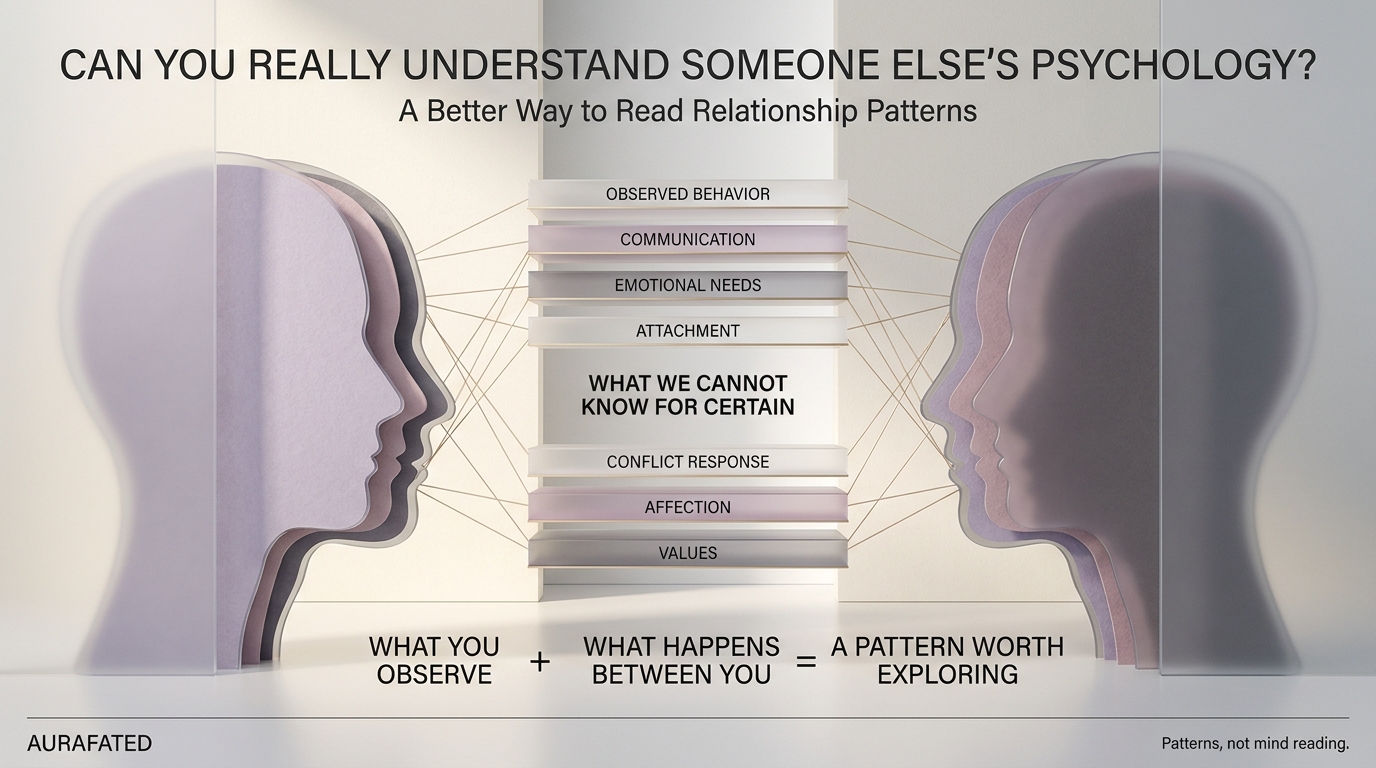
◇ Six Areas Worth Comparing
A useful relationship profile can organize information around six areas:
1. Emotional Needs
What helps each person feel secure, valued, and connected?
2. Attachment and Closeness
How does each person respond to intimacy, distance, reassurance, and uncertainty?
3. Communication Style
How directly does each person express needs, emotions, and disagreement?
4. Conflict Response
Does each person pursue, withdraw, compromise, escalate, or seek immediate resolution?
5. Affection and Love Expression
How does each person tend to give and receive affection?
6. Compatibility and Friction Patterns
Where do the two styles naturally fit—and where are misunderstandings likely?
♡ What Relationship Analysis Cannot Tell You
There are important limits.
A responsible relationship analysis cannot guarantee:
- what another person secretly thinks
- whether they are definitely in love
- whether they will stay or leave
- what they will do in the future
- the hidden motive behind every behavior
If you need certainty about what someone feels, eventually the most reliable source is the person themselves.
◉ What It Can Do Instead
A careful analysis can help you notice:
- recurring behavioral patterns
- mismatched emotional needs
- different communication styles
- attachment-related tendencies
- conflict cycles
- areas of reciprocity
- areas of persistent friction
Most importantly, it can help you decide what questions need to be asked directly.
✦ A Better Question Than “What Are They Thinking?”
Instead of asking:
“What are they secretly thinking about me?”
try asking:
“What does their consistent behavior tell me about how this relationship currently functions?”
That question is usually more answerable.
It also shifts attention from speculation toward information you can actually use.
✧ Patterns, Not Mind Reading
AuraFated’s goal is not to claim access to another person’s private mind.
Instead, the goal is to compare perspectives.
Your psychology.
Their self-reported information, if available.
Observed behavior.
The interaction between you.
Traditional Saju interpretation as a separate lens.
Patterns, Not Mind Reading.
Notice what is consistent.
Notice what contradicts.
Notice what happens between the two of you.
Then ask the questions that observation alone cannot answer.
Explore Your Relationship Patterns
AuraFated explores relationships through multiple perspectives while keeping observation, psychological reflection, and traditional interpretation clearly distinct.
Explore Your Free Detailed Saju Analysis♡ Hidden Heart
Hidden Heart is designed to explore relationship dynamics by comparing available birth information, observed patterns, emotional themes, and the interaction between two people.
It is an interpretive relationship experience and does not claim certainty about another person’s private thoughts, motives, or future actions.
Preview Hidden Heart✦ Complete Soul Profile
Complete Soul Profile is designed to integrate attachment reflection, Big Five personality patterns, Love Language preferences, Korean Saju, and other self-discovery perspectives.
The focus is on where patterns agree, where they conflict, and what those connections may help you understand.
Learn About Complete Soul Profile
Observe the behavior.
Understand the interaction.
Ask what still needs to be said.