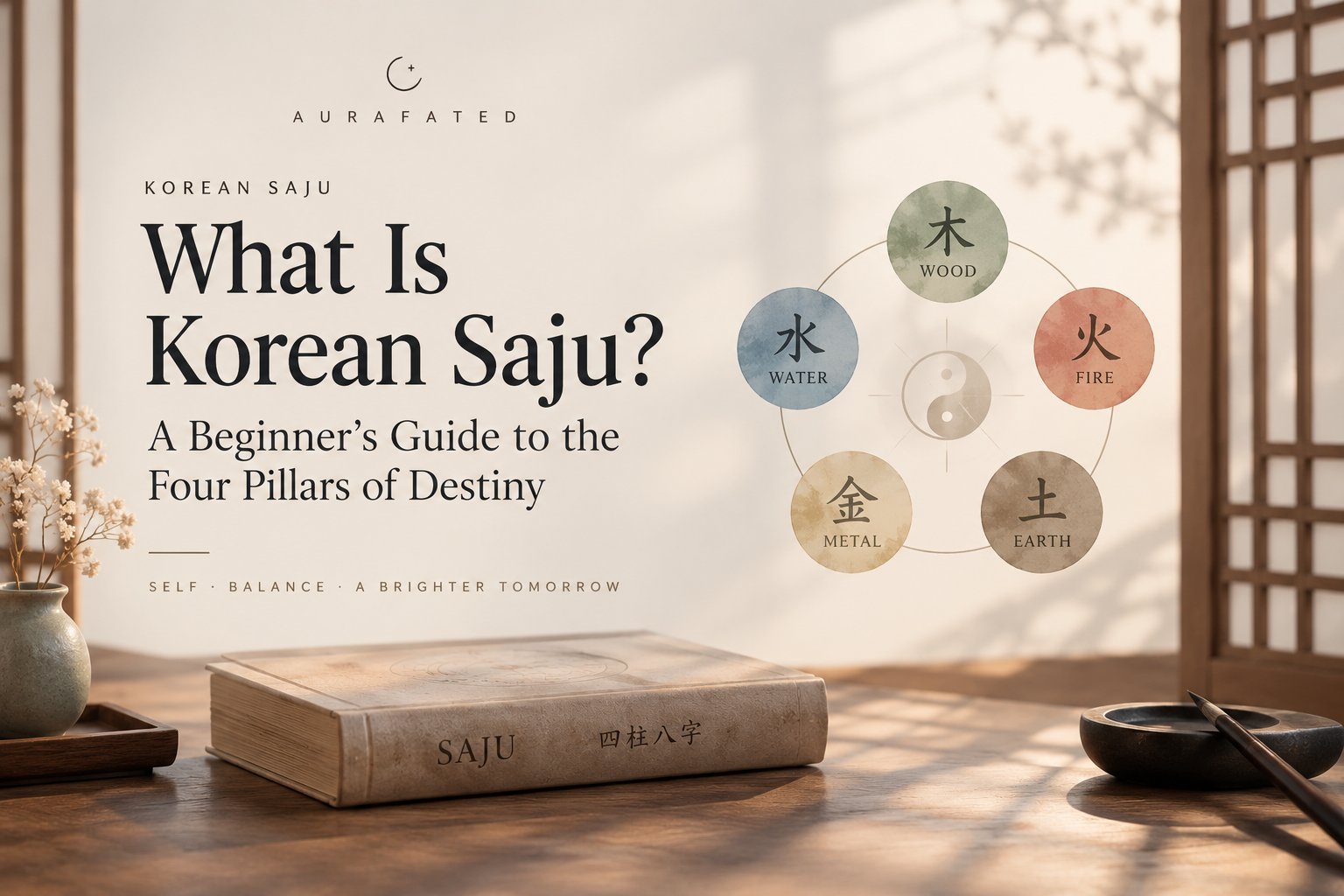
What Is Korean Saju?
A Beginner’s Guide to the Four Pillars of Destiny
If you have ever heard someone in Korea ask:
“What time were you born?”
there is a good chance the question had something to do with Saju.
Korean Saju—often called Saju Palja (사주팔자, 四柱八字)—is a traditional East Asian system for interpreting a person’s birth information.
Unlike a simple zodiac sign based mainly on your birth date, Saju traditionally considers four parts of your birth:
Year · Month · Day · Hour
Together, these form what are known as the Four Pillars.
Each pillar contains two characters, producing eight characters in total—which is why the expression Saju Palja refers to Four Pillars and Eight Characters.
What can Saju tell you—and what can’t it tell you?
☯ The Four Pillars: Year, Month, Day, and Hour
A traditional Saju chart is constructed from four components of your birth information:
年 Year Pillar
Your birth year
月 Month Pillar
Your birth month
日 Day Pillar
Your birth day
時 Hour Pillar
Your birth hour
Each pillar contains one Heavenly Stem and one Earthly Branch.
Four pillars × two characters = eight characters.
But a traditional Saju reading does not simply look at eight characters individually.
It looks at how they interact.
木 火 土 金 水 — The Five Elements
One of the most recognizable parts of Saju is the system of the Five Elements, traditionally called the Five Phases.
木 Wood
Traditionally associated with growth, development, flexibility, and expansion.
火 Fire
Traditionally connected with expression, intensity, visibility, warmth, and movement.
土 Earth
Associated with stability, grounding, structure, and support.
金 Metal
Often connected with discipline, boundaries, precision, organization, and decisiveness.
水 Water
Traditionally associated with adaptability, depth, reflection, flow, and intelligence.
How the Five Elements Work Together
However, Saju does not interpret each element in isolation. Instead, the chart considers how Wood, Fire, Earth, Metal, and Water support, control, strengthen, or weaken one another.
Therefore, having more of one element does not automatically mean that element is “better.” The broader pattern and balance of the chart matter more than simply counting individual elements.
A Saju chart does not simply ask:
“Which element are you?”
It looks at the relative balance and relationships among the elements.
A person may have several elements represented strongly, weakly, or in different relationships with one another.
☯ Yin and Yang
Saju also incorporates the traditional concepts of Yin and Yang.
These are not simply “good” and “bad.”
They represent complementary qualities.
Yang
May traditionally be associated with outward movement, activity, directness, and expression.
Yin
May be associated with inwardness, receptivity, subtlety, reflection, or containment.
Both are necessary within the traditional framework.
The goal is not to be “more Yang” or “more Yin.”
◎ The Day Master: The Center of the Chart
One of the most important concepts in traditional Saju interpretation is the Day Master.
The Day Master comes from the Heavenly Stem of the Day Pillar.
Traditionally, it is treated as an important reference point for understanding the individual within the chart.
From there, the rest of the chart is interpreted in relation to it.
A Saju chart is much more than “I was born in a Fire year, so I am a Fire person.”
✦ Saju Is Not the Same as the Chinese Zodiac
This is one of the most common misunderstandings.
Someone may say:
“I was born in the Year of the Dragon.”
That represents only one portion of a Four Pillars chart.
Saju also considers:
- month
- day
- hour
- Heavenly Stems
- Earthly Branches
- Five Elements
- Yin and Yang
- interactions within the chart
Two people born in the same zodiac year can therefore have very different Saju charts.
◇ What Does Saju Traditionally Explore?
Historically and culturally, Saju has been used to interpret a wide range of life themes.
Personality
Traditional interpretations may describe tendencies related to temperament, independence, caution, expression, discipline, adaptability, or emotional style.
Relationships
Saju has traditionally been used to explore relationship tendencies and compatibility.
Career and Work
Some interpretations examine how different elemental patterns may relate to work tendencies, leadership, structure, creativity, or autonomy.
Life Cycles
Traditional Saju also includes systems for interpreting changing periods or phases of life.
Timing
Some readers use Saju to examine periods traditionally considered more favorable or challenging for certain activities.
These are traditional interpretations, not scientifically established predictions.
✧ Is Saju Scientific?
This deserves a direct answer.
AuraFated does not present Saju as a scientifically validated personality test or predictive science.
Saju is a traditional interpretive system.
Modern psychological personality assessment operates differently. Psychological instruments are evaluated using concepts such as reliability, validity, measurement consistency, and empirical testing.
That does not mean a traditional system cannot be culturally meaningful or personally interesting.
It means we should be clear about what kind of system we are using.
◉ Then Why Explore Saju at All?
Because people do not explore themselves only through laboratory measurements.
Human beings have always used stories, symbols, philosophy, traditions, personality frameworks, and family narratives to think about who they are.
Does this interpretation help me notice something about myself that I want to examine more closely?
That is a very different question from asking whether Saju can scientifically prove who someone is.
And it is the question AuraFated prefers.
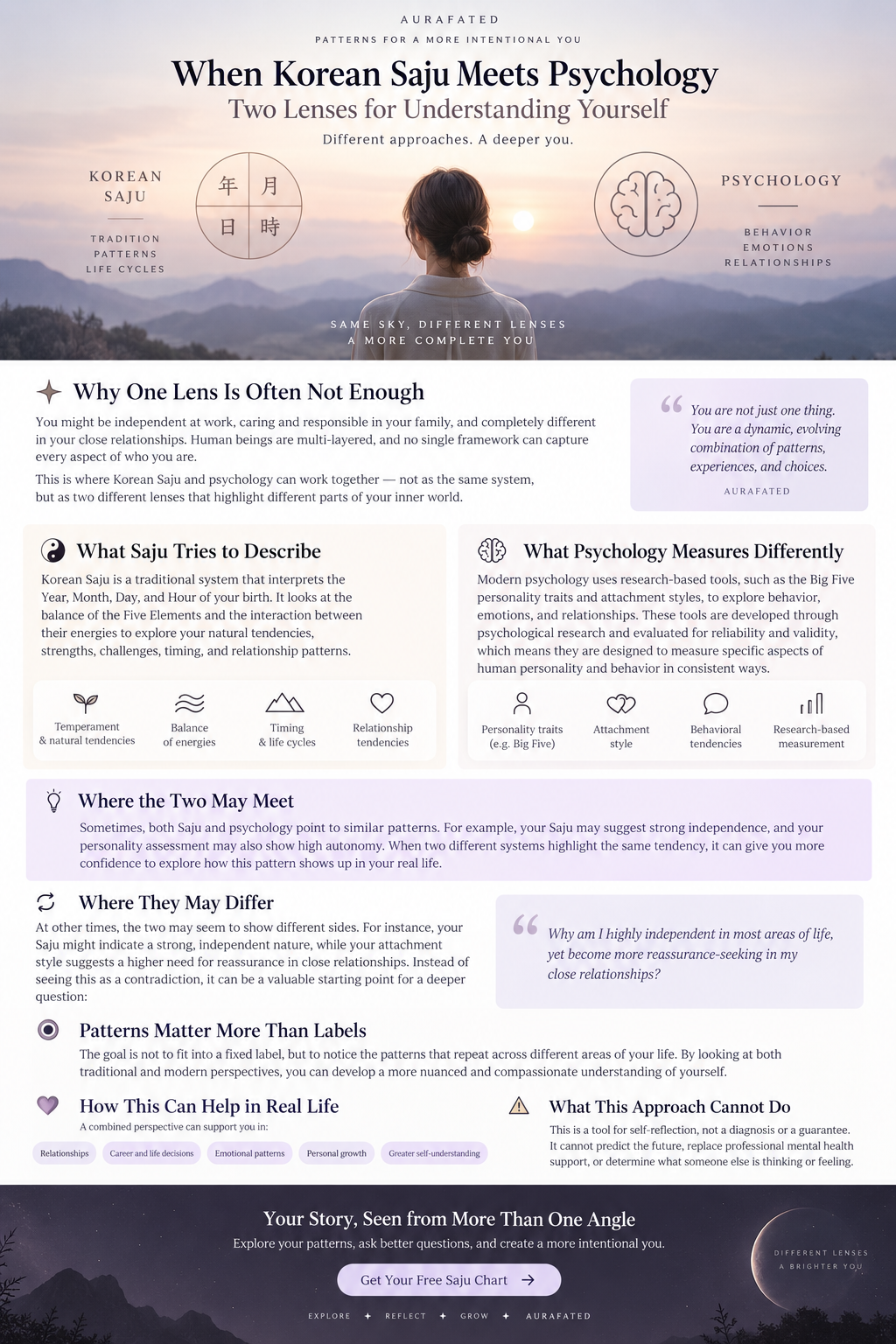
⇄ Saju and Psychology: Two Different Lenses
Suppose a Saju interpretation describes someone as strongly independent.
A psychological personality assessment also suggests:
- high autonomy
- low need for external approval
- strong self-direction
Interesting.
But this does not mean the psychological result scientifically validates the Saju result.
It means two different frameworks have generated a similar observation.
Now suppose the same person’s attachment assessment shows a strong need for reassurance in romantic relationships.
That apparent contradiction may actually be more useful than agreement.
Maybe that person is independent in everyday life but vulnerable in intimate relationships.
That is a richer question.
✦ A Saju Chart Is Not a Sentence
One phrase we want to avoid is:
“Your Saju says this will happen.”
That treats an interpretive tradition as if it were a guaranteed future.
AuraFated takes a different approach.
Traditional interpretations may suggest tendencies, symbolic relationships, strengths, tensions, recurring themes, and periods traditionally interpreted in different ways.
But your actual life is also influenced by:
Family × Culture × Education × Relationships × Opportunity × Habits × Choices × Circumstances
♡ What About Saju Compatibility?
Compatibility is one of the areas people are most curious about.
Traditional Saju compatibility may compare the patterns within two birth charts.
But relationship quality cannot realistically be reduced to birth information alone.
Real relationships are influenced by:
- communication
- attachment
- trust
- values
- emotional regulation
- expectations
- conflict behavior
- life circumstances
Where might two people naturally understand one another—and where might they repeatedly misunderstand one another?
✧ Birth Time Matters—But Don’t Panic If You Don’t Know It
Because the traditional Four Pillars system includes an Hour Pillar, exact birth time can add information to a Saju chart.
But many people do not know their exact birth time.
That does not mean they cannot explore Saju at all.
A reading may still examine the available year, month, and day information while recognizing that the Hour Pillar is missing.
The important thing is transparency.
◇ What AuraFated Looks for in a Saju Reading
AuraFated is particularly interested in patterns rather than dramatic predictions.
- What themes appear repeatedly?
- Where does the chart traditionally suggest balance or tension?
- What characteristics might be worth reflecting on?
- Do any of these themes also appear in your psychological assessments?
- Where do the different systems disagree?
- Does the interpretation match your lived experience?
- If it does, how does that pattern affect your choices?
✦ Your Experience Still Matters More Than the Interpretation
Imagine receiving a Saju interpretation that says you are highly structured.
But your actual life is chaotic.
The interpretation may simply not fit you.
Or perhaps you prefer structure internally but have lived in circumstances where maintaining it was difficult.
Or maybe you became more structured later in life.
Your real experience gets a vote. Actually, it gets the most important vote.
✧ Patterns, Not Predictions
This brings us back to one of AuraFated’s central principles:
Patterns, Not Predictions.
Saju can be explored as one traditional lens.
Psychology can provide another.
Personology may provide another.
Your history provides another.
Your relationships provide another.
And your choices continue to shape what comes next.
No single interpretation gets to own your identity.
☯ Curious About Your Own Saju?
☯ Ready to Explore Your Own Patterns?
AuraFated offers different levels of exploration—from free Saju readings to deeper relationship and personality experiences.
☯ Detailed Saju Analysis
Want to go beyond a basic Four Pillars reading? AuraFated’s detailed Saju analysis explores your chart in greater depth.
✦ Day Master
木 火 土 金 水 Five Elements balance
✦ Strengths and challenges
✦ Major luck cycles
♡ Relationship tendencies
✦ Career alignment
◎ Broader personal patterns
✧ Life Fortune
Prefer a simpler reading focused on the broader path of your life?
Life Fortune offers a concise Four Pillars overview together with traditional themes such as:
◇ Early-life fortune
◇ Middle-life fortune
◇ Later-life fortune
◇ Sibling fortune
◇ Children fortune
♡ Marriage and partnership
✦ Career fortune
Want to Go Deeper?
Some questions require more than a quick reading. AuraFated is developing deeper experiences for relationships, personality, and integrated self-understanding.
♡ Hidden Heart
Some of the hardest questions are not about ourselves alone. They are about what may be happening between us and someone important.
Hidden Heart explores:
♡ What they show vs. what they hide
♡ How they may truly feel about you
♡ What they may struggle to say
⇄ The emotional dynamic between you
⚠ What to watch for
✦ The gift in the connection
→ Where the connection may be heading
✧ A reflective message for you
Hidden Heart is an interpretive relationship experience and does not claim certainty about another person’s private thoughts.
Preview Hidden Heart✦ Complete Soul Profile
AuraFated’s most comprehensive self-discovery experience brings together multiple perspectives instead of relying on a single test.
☯ Korean Saju
✦ Zodiac and Personology
◉ Big Five Personality
♡ Attachment Style
♡ Love Language Profile
✧ Image Intuition Analysis
◇ Unconscious-Pattern Reflection
◐ Shadow and Gift Analysis
♡ Ideal Partner Profile
◎ Integrated Pattern Analysis
Not just separate results.
We look at how the patterns connect.
Start free. Explore what resonates.
Go deeper when you are ready.
✦ Fortune Readings
Explore a collection of quick, free AuraFated readings for curiosity, reflection, and fun.
Tarot · Zodiac · Compatibility · Dream Interpretation · Destiny City · MBTI Fortune · Palm Reading · Face Reading · Numerology · Lucky Numbers · Name Analysis · Feng Shui · Oracle Chat
These experiences are designed to be simple and accessible, with no purchase required.
Explore Free Fortune Readings